


By Solomon Gilliam and Nicole Ferdinardo
@redlineproject
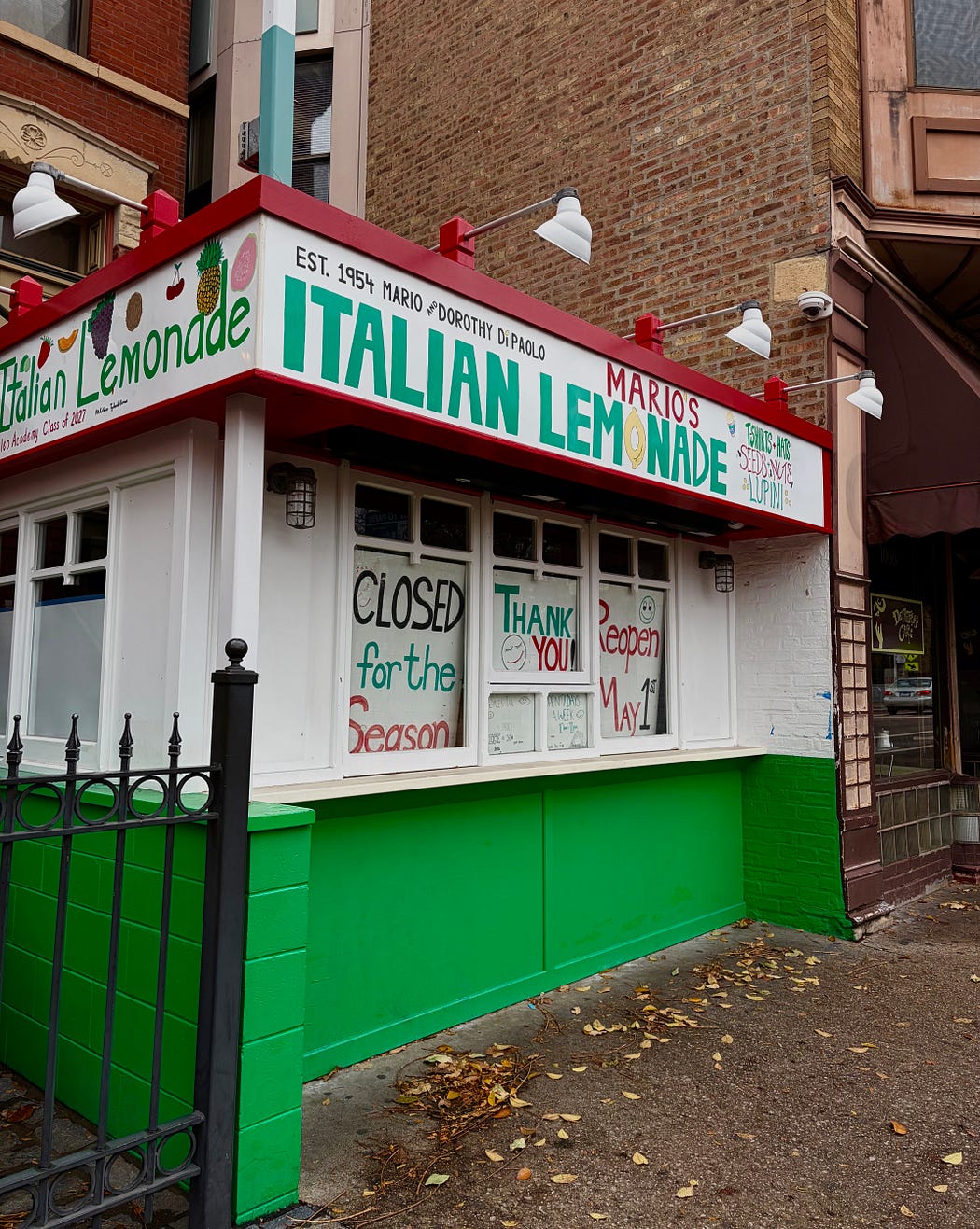
The longtime popular Mario’s Lemonade Stand in Little Italy. (Photo/Nicole Ferdinardo)
Little Italy’s Taylor Street was once defined by its sense of family, a close Italian-American community where everyone knew everyone. However, with shifting demographics, longtime Italian businesses closing and new trendy diverse spots moving in, residents and workers are asking if the name Little Italy still fits.
“I used to deliver groceries to the old-timers, they would wait for me with cookies or other baked goods,” said Angelica Perez, a 31-year employee of Fontano’s Subs. She said she considers Little Italy her second home.
“Everyone helped everyone,” she said.
Little Italy wasn’t just a place to eat Italian food, it was a community built on routine, loyalty and deep personal connections. Not only did neighbors live side-by-side, but they actively participated in one another’s lives.
“Everybody watched everybody, like ‘oh, do you need something? Let me help you,’” Perez said.
“We didn’t sell coffee, but because it was the neighborhood, the owner used to make it in the back, and I used to come and bring it to them.”
The neighborhood operated like a big family. People regularly did things for each other out of kindness, which created a unique rhythm to daily life; it gave the neighborhood its character just as much as the food.
“When I started 31 years ago, the neighborhood was a lot of old timers, [they were] very nice people,” Perez said.
But the Little Italy of today looks different. Over the past few decades, Little Italy has faced changes due to several factors.
Curtis Winkle, University of Illinois Chicago Urban Planning and Policy Professor, has lived in Little Italy for 10 years. He said that when UIC was built, it “decimated part of the neighborhood.”
Winkle said that Little Italy’s changes resemble the ecology theory, “invasion and succession,” described by the Chicago School of Urban Ecology, which is when one group gradually replaces another.
Winkle described one conflict that may have reflected the changing demographics of the area: the removal of the Christopher Columbus statue in Chicago’s Arrigo Park. Following the demonstrations related to George Floyd’s death in 2020, the city decided to remove the statue.
Many activists viewed the statue as a symbol of oppression. However, some Italian Americans and residents of Little Italy viewed it as a part of their heritage and connection to America. As a result, counterprotests took place advocating for the return of the statue. Winkle even reported seeing the Proud Boys at one counter protest.
“I think that [the statue removal] better represents a student’s way of looking at the world, versus an Italian neighbor’s way,” Winkle said. The dispute is another representation of how the neighborhood now accommodates a wider demographic, a contrast that many residents have noticed firsthand.
Said Perez, “Now, I think it’s more university. A lot of the old-timers are gone … they passed. They were very elderly when I came around.”
Times have changed in the Chicago neighborhood, including shifting demographics of people and businesses, prices and population.
Today, the neighborhood faces a dilemma. UIC’s growing student population shapes more of the foot traffic, and new restaurants offer tastes that are far outside of the area’s historic identity.
As the original traditions fade, and new trends continue to pop up, residents and workers face the question: What does Little Italy become when the traditions that built it no longer hold the spotlight of the area?
Historically, the Taylor Street corridor was the heart of Chicago’s Italian immigrant community. The city’s foreign-born Italian population peaked in 1930 at 73,960, with Little Italy serving as a central place of settlement, according to the Encyclopedia of Chicago. For ages, the area was filled with Italian grocery stores, bakeries, and restaurants owned by families who had lived there for generations.
But as Italian families moved into the suburbs in the late 20th century, and as UIC expanded its campus, the community’s identity began to shift. Today, according to 2020 census data, the Little Italy area (60607) is 53% White, 23% Asian, 12% Black, 9% Latino, and less than 1% American Indian or Pacific Islander. In just one generation, Little Italy has shifted from being predominantly Italian to one of the more diverse neighborhoods of Chicago.
Winkle said that these shifts have also changed the way people refer to the area. He hears people refer to it as both University Village and Little Italy.
“Losing some key institutions like Rosebud and others gets people to reframe it,” Winkle said.
Still, many residents and workers disagree on what that means for the area’s cultural identity. The longtime Fontano’s worker, Perez, admitted that the name “Little Italy” may not reflect the current population anymore.
Still, she enjoys all of the university students who eat there. “I see their faces every day, I already know them by their name or what they like.”
There is still a strong community in Little Italy, but it looks different than before.
Alongside traditional family-run Italian restaurants, Little Italy now features new modern and cultured spots. Some spots in particular include Two Shades Cafe, a modern coffee shop at 1152 W. Taylor St., Kurimu, an Asian-influenced dessert shop at 1159 W. Taylor St., and Taylor’s Tacos, a black-owned taqueria at 1512 W Taylor St.
These new and diverse spots cater to young residents and students. While these businesses bring in fresh energy and new crowds, their growth also raises concerns among longtime residents who feel that the neighborhood’s Italian culture may be becoming diluted.
These additions reflect the neighborhood’s evolution; however, they also contribute to the ongoing debate about whether the “Little Italy” name truly represents the modern-day community.
“There are a lot of restaurants that are no longer here, that are being replaced by different cultural restaurants,” said Dominican University student Vedrana Gotovac, who grew up visiting her grandparents in Little Italy. She said that it has changed since she was younger.
“One restaurant that I remember specifically was Leona’s,” Gotovac said of the famous Italian restaurant. “I would go there all the time when I was younger with my grandparents, and it is no longer here in Little Italy.”
Vedrana said she believes that the neighborhood is losing a lot of its tradition.
“I don’t know if I would call it Little Italy, cause, you know, it’s changed, right? Change is good sometimes,” Perez said.