


By Oscar Hidalgo and Joshua Zapata
@redlineproject
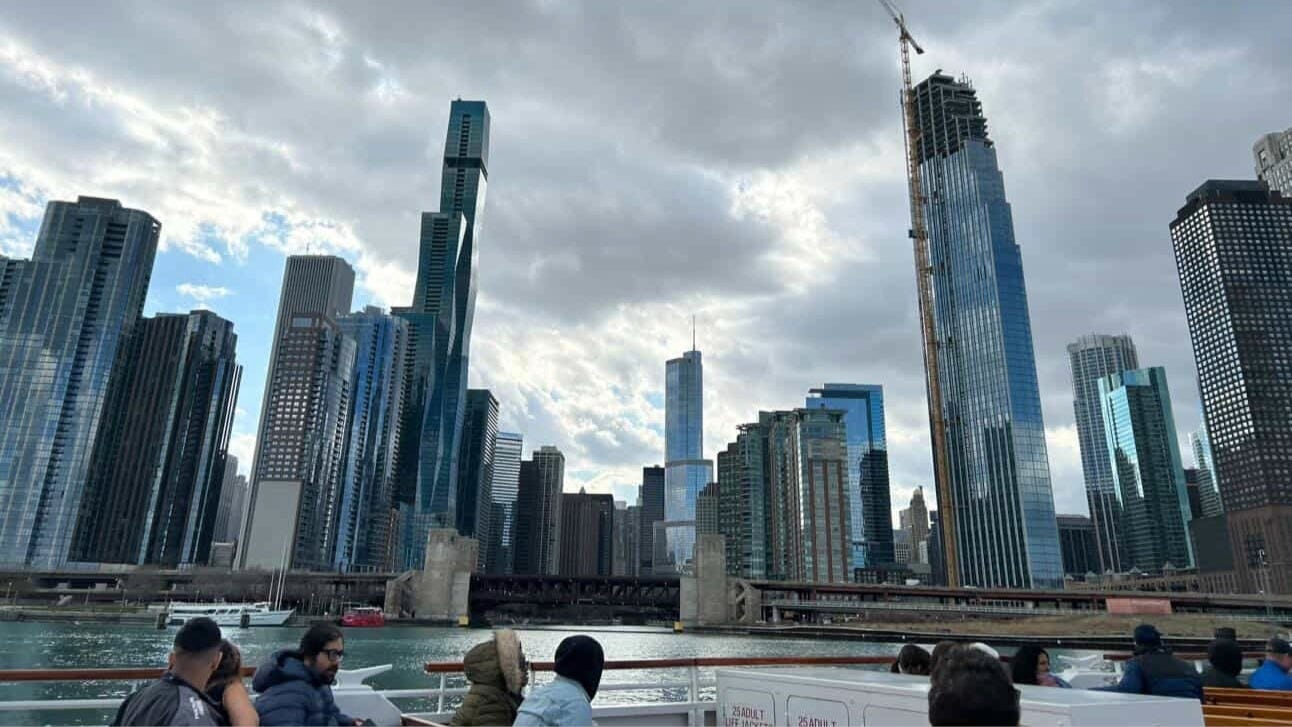
Architecture Tour from Navy Pier in April. (Photo/ Oscar Hidalgo)
One busy afternoon along the Chicago River, tour boats and yachts glide past the glass towers as visitors gaze at the city’s skyline, snapping photos of Chicago’s architecture.
But few people stop to think about what lies beneath the water.
Below the waterline, an environmental threat decades in the making is slowly creeping toward Lake Michigan — the Asian carp.
Scientists and environmentalists warn that if Asian carp establish themselves in Lake Michigan, the consequences could be severe. The invasive species known for consuming large amounts of plankton, reproducing rapidly, and growing to enormous sizes has the potential to disrupt the lake ecosystem, threaten native populations and damage industries that depend on the Great Lakes, including commercial fishing and tourism.

An Asian carp at the Shedd Aquarium of Chicago (Photo/Joshua Zapata)
Asian carp were originally introduced in the southern United States to control algae growth, but have since spread through the Mississippi River over the past decades. Their expansion toward Chicago’s waterway systems have raised alarms of researchers and conservationists.
The Great Lakes Fishery Commission, a treaty-based organization formed by the US and Canadian governments, stands at the forefront of prevention efforts.
“Invasive carp have not yet established themselves in the Great Lakes,” said Jill Wingfield, director of communications with the Great Lakes Fishery Commission. “Prevention is step one: keeping them from getting into the Lake.”
The organization employs multiple strategies to prevent Asian carp from reaching Lake Michigan. Electric barriers in the Chicago-area waterway system serve as the first line of defense, as studies have found that invasive carp are repelled by minor electricity.
“The Chicago area waterway system is primarily shipping canals with big barges moving through so there aren’t a lot of economically important fish species that we need to worry about harming,” Wingfield said.
In a new partnership, the commission works with commercial fishermen to remove as much of the invasive carp as possible.
This year’s total figure is more than 7 million pounds.
“More than 1.2 million pounds of fish have been removed from the Chicago water system via commercial fishers” Wingfield said. “The partnership with the commercial fisheries is unlike anything I’ve ever seen before. We’ve never partnered with a commercial fishery to remove a fish that doesn’t necessarily have a market value.”
What makes an Asian carp particularly dangerous to waterways is their voracious appetite, which allows them to grow to enormous sizes.
“They eat up to 40 times their body weight a day.” Wingfield said. “They’re filter feeders, so they’re eating microscopic zooplankton and phytoplankton, by hitting that bottom of the food web, that means that the smaller invertebrates don’t have anything to eat, which means the small fish don’t have anything to eat, which affects the whole chain. “Mind you these fish can weigh up to 100 pounds.”
The Asian carp have also developed a clear public safety risk. Unlike many other invasive species, the Asian carp are known for leaping or jumping out of the water when startled by the boat engines, sometimes injuring boaters. This has drawn a public attention to the issue.
“There aren’t a lot of invasive species that have a direct human health impact,” Wingfield said. “This put a new light on the situation when we had people showing up to the ER with bloody noses and concussions from getting knocked off the jet skis.”
Wingfield stressed the importance of protecting Lake Michigan.
“The Lake is so important to Chicago, at the end of the day, it’s an ecosystem, It’s important the conservation efforts that are going on to protect these water systems.” she said.
Despite the importance expressed by the expert, the threat remains largely invisible to those who work on the Chicago River every day.
Ashley Kennedy a architecture docent at Shoreline Sightseeing boat tours in Chicago, said, “I’ve never seen them in the river, I know they’re a potential threat, but more further down south.”
Asian carp are widely recognized for their behavior of jumping out of the water when disturbed by boat engines, sometimes injuring boaters in other regions. Kennedy said, “they’re the ones that jump, but I’ve never seen a fish jump here, That’s a good sign.”
Kennedy said that the Asian carp have not affected boat tours or customer experiences.
She added that most tourists are not widely aware of the issue, unless they already have an environmental interest: “Not too many people know about it, it’s kind of a niche thing, I’ll just bring it up briefly during tours.”
Kennedy said she’s concerned about the long-term ecological risk if Asian carp reach Lake Michigan, pointing to a gap in current prevention systems.
“If they get through, that would be a disaster for the Great Lakes ecosystem, they’re invasive and not supposed to be here,” she said.
For now the daily life of the Chicago River continues uninterrupted. Boats continue their routes, the tour guide continues delivering the Chicago agricultural, and the visitors the city from the water.

Lake Michigan and the Chicago Skyline (Photo/ Joshua Zapata)
Kennedy referenced the electric barrier system in the Chicago Area Waterway System, noting concerns that the smaller fish could pass through when barges move.
“The concern is that the little ones can sneak through, I just hope they find a solution,” she said.
While Kennedy said she believes agencies are responsible for containment, she indicated that businesses where she works have limited control over the situation.
“It’s in their hands now, we can’t really do anything about it,” she said.
Overall, the Chicago waterways continue to operate, tour boats, yachts move through the rivers and Lake Michigan, and visitors admire the city of Chicago of the skyline, and the threat of invasive carp remains largely out of sight and out of mind.
But experts warn that prevention is a continuous process, not a finished solution. Whether the current prevention efforts will be enough remains an open question. Scientists continue to monitor the spread of Asian carp.
Your thoughts
Visit GLFC.org to learn how you can support Asian carp prevention.