


By Emre Zor
Art direction by Emre Zor | Art by ChatGPT
AI disclosure: ChatGPT was used to outline part of this story and create images. Perplexity was used to generate research sources. Summarizer 2 and NotebookLM were used for the summary and audio, respectively.
Summary
- Artists struggle with financial instability and rely on multiple income sources
- Passion for creating art continues despite economic and systemic challenges
- Funding is limited and difficult to access due to competition and bureaucracy
- The art world depends on resilient artists navigating uncertainty
Claire Burke Dain was watering flowers during her shift at a florist job, while unfinished paintings waited back in her studio. She also teaches at the University of Illinois Chicago, splitting her income between living expenses and tuition for her MFA.
Although painting is what she cares about most — she spends nearly eight hours a day in the studio — her income depends on part-time work and teaching.
Dain challenges the idea of comfort in her paintings by adding figures that intrude and distort the subject. In “Stair,” for example, she painted stairs that rise to the nose of a human face, but at the top, instead of a nose, a small silhouetted figure waits.
“Everything is a waiting game,” Dain said. “Money will always be a stressor. It definitely causes stress and makes things less stable and more uncertain.”
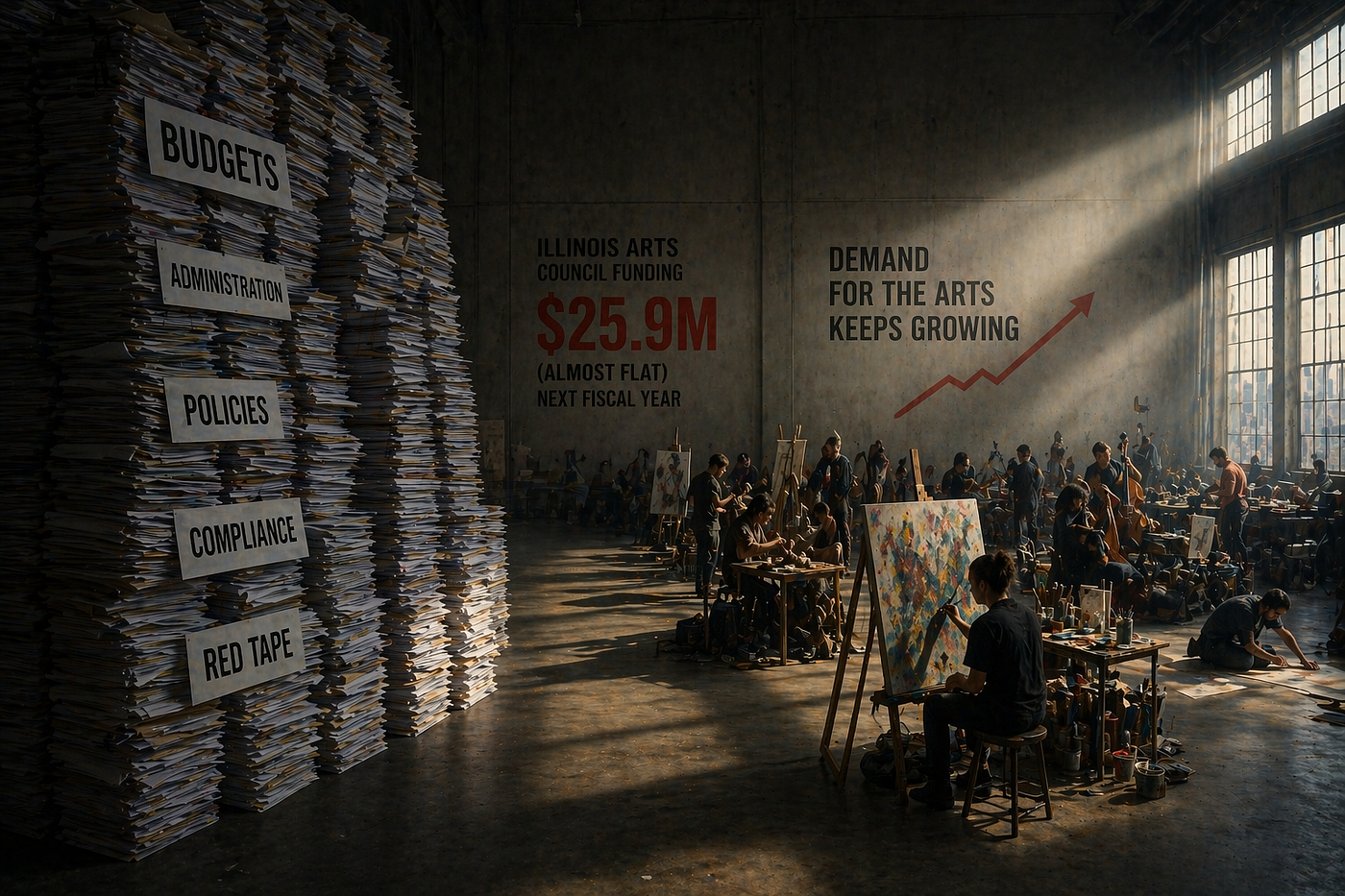
Local artists, like Dain, learned in February that Illinois Governor JB Pritzker’s proposed $56 billion budget keeps art funding for the Illinois Arts Council (IAC) nearly flat at $25.9 million next fiscal year.
This proposal came at a precarious moment for the arts nationwide. Since returning to the presidency, Donald Trump has rescinded grants from the National Endowment for the Arts, moved to shut down the Kennedy Center for renovation after seizing oversight of the institution, and ordered a broad audit of Smithsonian exhibitions.
Calls for Increased Arts Funding
Advocates say stagnant funding is especially concerning as demand continues to grow.
“The demand for arts and cultural investment is growing but funding and policy have not kept pace,” said Sasha Ongtengco, director of programs for creative workers at Arts Alliance Illinois, the statewide arts advocacy organization. “IAC funding is still below 2007 levels adjusted for inflation. Arts Alliance has asked the General Assembly for a 20% increase to the arts budget to meet the growing need.”
Arts Alliance Illinois announced it has launched a new statewide study examining “the economic power, infrastructure, and future potential of the Illinois creative economy,” scheduled for release in June.
“For too long, the creative economy has been discussed mainly in cultural terms instead of as essential economic infrastructure,” said Claire Rice, executive director of the Arts Alliance.
Created by NotebookLM and Descript
57% of artists worry they may not afford essential needs
At the city level, Chicago’s Department of Cultural Affairs and Special Events (DCASE), which saw a 15% funding cut during the latest budget cycle, awards grants to individual artists and organizations through programs like the Individual Artists Program. It awarded nearly 250 artists out of 1,300 applicants in 2025.
According to the National Assembly of State Arts Agencies, individual artist grants given by state arts agencies more than tripled between 2012 and 2021, with acceptance rates hovering around 15% to 20%.
However, NORC’s study shows artists face significant financial insecurity and complex work arrangements. Around 57% of artists reported being “somewhat or very worried” about being able to afford “food, housing, medical care, or utilities,” and 34% of artists are self-employed, with 11% reported “juggling three or more jobs.”
Ongtengco said the median income for Midwest artists’ primary job hovers around $18,000, with a majority working part-time or in temporary roles and nearly half performing uncompensated labor.
Meanwhile, demand for funding continues to surge. The Illinois Arts Council reported a 120% increase in grant applications in the 2025 fiscal year.

Art direction by Emre Zor | Art by ChatGPT
‘I know at any time my hobby may not be financially supported anymore’
Adriana Miranda, a Chicago-based independent mixed-media artist, applied for grants and funding around 2016–2022 but “never found any success.”
“It was very competitive and very saturated,” Miranda said. “It was also hard to know exactly what the grant providers were looking for. When you submit art-related things, the panel likes certain photography methods to showcase artwork, and there’s no way of knowing anything past formatting requirements.”
Miranda began focusing more on exhibiting artworks after losing hope of securing grants and funding. She sells five to 10 paintings a month, although she calls it a hobby. Her main source of income is selling artworks, and she says she’s living on edge.
“People never need to buy art,” Miranda said. “Things can change in an instant. I think that is probably what gives me great comfort and confidence in myself, though, is that I know at any time my hobby may not be financially supported anymore, and I will still work at it.”
Red Tape in Funding
Grant dollars can be essential for artists, but they aren’t a quick fix. They usually involve a lot of red tape.
“Most of the time you don’t hear back until the selection process is over,” Dain said, who applied to many residencies that are fully funded and provide a stipend. “If you are a finalist they contact you either for an interview or further instructions to complete.”
Applications for city funds can be lengthy and cumbersome, requiring extensive reporting. For example, applicants must disclose any outstanding city debt, and in order to receive funds they must either pay their debt or set up a payment plan to cover those fees, such as parking tickets or unpaid water bills.
“It is part of being someone without a full-time job and steady income,” Dain said. “It can make hustling for money take precedence over work you are actually excited to make. But it’s all a balancing act.”
Ongtengco said the problem is not only how much funding exists, but how it is structured.
“Arts funding has often looked more like funding isolated projects vs. funding a system,” Ongtengco said. “But the arts and culture sector and its workforce are not at all extra, since the labor of working artists shows up in schools, libraries, local festivals, cultural institutions, and small creative businesses.”