


By Gabriel Palos
@redlineproject
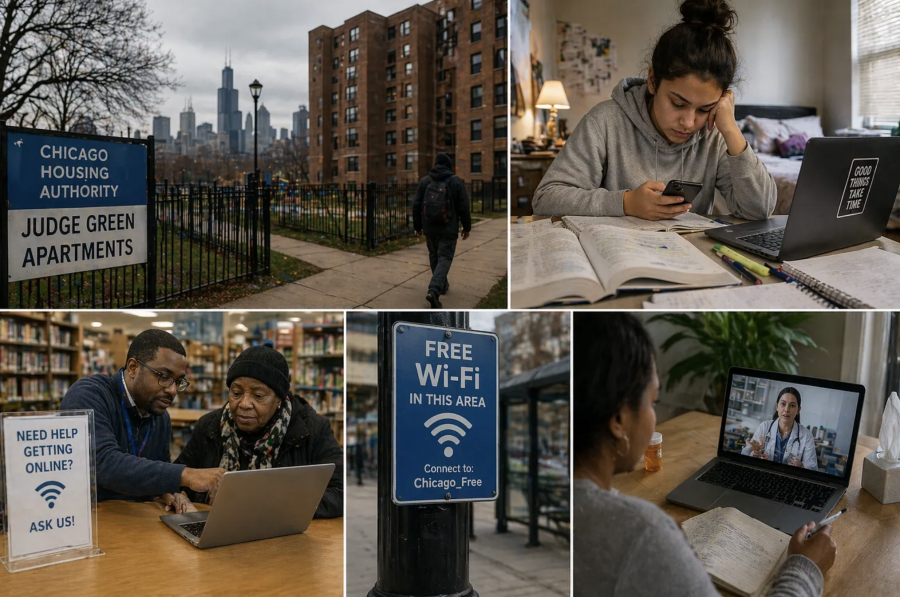
Art direction by Gabriel Palos | Art by DALL-E 3
AI disclosure: ChatGPT was used to outline and find sources for the story. DALL-E 3 and NotebookLM were used to create the images, while the video and podcast brief were generated by NotebookLM. The summary was generated by SummarizeWise custom GPT.
Summary:
- Thousands of CHA residents lack reliable internet due to cost, outdated infrastructure and inequality
- Digital divide impacts education, jobs, healthcare and daily life
- Programs like Chicago Connected help but gaps remain
- Experts urge investment in broadband, devices and digital literacy to close disparities
In Chicago, many people struggle to gain access to reliable, fast internet connection. But for thousands of residents living in housing run by the Chicago Housing Authority (CHA), this is a daily struggle.
Colin Rhinesmith, associate professor and director of the Digital Equity Action Research Lab at the University of Illinois Urbana-Champaign, said that outdated technology and issues with setting up wireless networks and upgrading them often cause divides in public housing.
However, he added that the major challenge is cost. For residents like Mary Ann Lang, these barriers directly impact daily tasks such as acquiring new skills, accessing information and keeping up in a technology-driven world.
For CHA residents, the digital divide is a daily struggle.
“In using the internet daily, it’s useful in finding information and a learning experience … learning about our city leaders gives me insight about their job position,” she said.
Computer classes through CHA helped in gaining access to new opportunities, including organizations like AARP and becoming more knowledgeable on various topics, despite the swift advancement of technology.
According to an April 2024 Block Club Chicago article, about 1 in 5 Chicago students lack broadband access at home, with “predominantly Black neighborhoods on the Southwest Side” dealing with the issue the most. Although Chicago has advanced infrastructure, gaps like these still exist, setting back residents in education, employment and fundamental services.
The Digital Divide: Gaps in Access
Reliable internet access has become just as fundamental to life as water. Research from the University of Chicago Civic Engagement states that “Burnside, West Englewood, Fuller Park, Englewood, and West Garfield Park have the lowest percentage of households connected to the Internet, each with over one-third of homes offline.”
A Government Technology article claims that the main reason is “not because of a lack of interest in going online. Rather, the main reason given is the cost.”
Civic Engagement, a partnership between institutions and communities that addresses public issues, points out and responds to these disparities. In this context, the University of Chicago’s Civic Engagement vision works with local neighborhoods to analyze struggles like broadband access. Their research claims that broadband connectivity greatly differs based on neighborhood, with South and West Side neighborhoods struggling to access high-speed internet. These gaps are a representation of ongoing economic disparity and segregation.
According to Pew Research, “The reasons for this low level of connectivity include a lack of wiring for broadband in older buildings, outdated networks that have not been upgraded, and low-quality or unaffordable service.”
Podcast: Listen to an AI-generated podcast brief on the research about the digital divide in Chicago Public Housing
“The challenges can be overwhelming,” Lang said. “Sometimes, I accidentally hit the wrong button, and it changes everything. This becomes frustrating when I don’t know how to retrieve my documents.”
Lang emphasized that CHA affiliated programs have made a huge impact on her life. “Having the willingness to continue to learn, search and ask questions makes all the difference.”
In terms of internet access, Lang made it clear that “the internet has become a necessity. Technology is important for adults as well as the next generation coming up.” She said she remains hopeful: “I hope [leaders] consider continuing to help the less fortunate in offering these services that have helped me along the way. It has allowed me to move forward in life.”
Educational Impact
This divide greatly impacts students.
Programs like Chicago Connected, which provides free high-speed internet for families in need, has expanded access to around 228,000 students. The Chicago Sun-Times, reported that “still, over 200,000 Chicago households still do not have high-speed internet. And over 260,000 households, nearly one in four, do not own a laptop or desktop computer.”
Effect on Jobs and Income
Education is not the only area affected by this problem. “Broadband can be particularly important for connecting low-income households with job opportunities and has been shown to boost employment,” according to Pew Research. Additionally, the research notes an interference with “workforce development opportunities.”
Rhinesmith highlights that the essentialness of reliable internet access for adults is reflected in the role of public libraries and community technology centers. Here, adults are often aided in writing resumes, job applications, and connecting to remote jobs on public computers. Without consistent internet access, these resources for better opportunities become more diminished.
Free Wi-Fi in public spaces is a partial solution, as limited hours, commuting issues, and privacy concerns reduce its effectiveness. This results in a growing economic divide between residents with stable internet access and those without.
Impact on Healthcare and Daily Life
A stable internet connection has also become increasingly necessary for healthcare and daily services. Ann & Robert H. Lurie Children’s Hospital of Chicago research found that “Incomplete visit rates and broadband access were inversely related,” with patients in low internet areas more likely to miss telehealth appointments, possibly leading to them experiencing more health inequities.
Beyond healthcare, everyday services essential to daily life, such as applying for government assistance or paying utility costs have also become gradually more digital. For residents with weak broadband, these tasks become longer and more frustrating, demanding multiple visits to public offices.
Homework Gap
To understand these challenges, Rhinesmith offered insight: “outdated technology and difficulty with upgrading or installing new wireless networks can create challenges. The major barrier is cost.”
During the pandemic, limited internet access led to the “Homework Gap,” driving students to use public Wi-Fi in library parking lots. Libraries are a source for internet, computers, digital skills training, and ongoing support, which are necessary for students and adults.
For adults, unstable internet reduces opportunities for employment, remote work and career growth. Digital Navigators, which are usually public librarians, help residents navigate online healthcare, government programs, and digital skills support.
Rhinesmith recommended “ongoing investments in high-speed broadband infrastructure access and Digital Navigators” and commends Chicago as a national leader in digital equity efforts.
“Don’t forget that not everyone has access to high-speed, affordable, and reliable internet in Chicago,” he said. “Let’s continue to keep Chicago a leader in developing innovative, community-led solutions to address this persistent societal challenge.”
Efforts to Reduce Disparities
As previously referenced, Chicago Connected provides high-bandwidth connectivity and devices to tens of thousands of Chicago Public Schools students and families. By 2021, the program aided 64,000 students in 42,000 households.
However, Rhinesmith stresses that more work is needed. He promotes ongoing funding in high-speed broadband and support for Digital Navigators, as these resources are vital for students and adults alike that are lacking stable home internet.
According to the Chicago Digital Equity Plan, nearly 172,000 Chicago households (over 15%) do not have internet service at home, and nearly 92,000 (roughly 8%) do not have any device. Strategies to address this digital divide include expanding affordable high-speed internet, providing devices and training, and promoting digital literacy.
Conclusion
Limited internet access is a hindrance that impacts education, employment, healthcare, and everyday life for thousands of people, especially CHA residents.
Programs like Chicago Connected have helped students, but disparities remain for adults who lack digital essentials. As Rhinesmith stressed, these difficulties involve cost, infrastructure, and enduring inequalities throughout neighborhoods.
Lang pointed to the ongoing severity of this issue, saying that “the internet has become a necessity. Everything is connected to computers and the internet. The challenges can be overwhelming.”

Art direction by Gabriel Palos | Infographic by NotebookLM