


By Arturo Gutierrez and Citlaly Rodriguez
@redlineproject
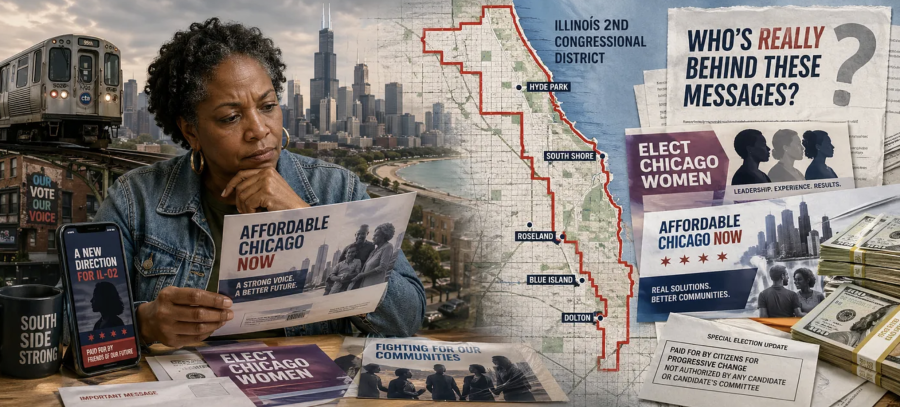 Art direction by Arturo Gutierrez | Illustration by DALL-E 3
AI disclosure: ChatGPT was used to generate the images and assist with story editing. Google Gemini was used to help research, brainstorm and support the outline. The summary was generated by SummarizeWise custom GPT. The video and infographic were generated by NotebookLM using contents of the story.
Summary: Donna Miller’s congressional bid gained and lost a key endorsement over AIPAC funding, highlighting debates about outside money in elections. Despite millions spent through opaque PACs, Miller won the 2026 Democratic primary.
On Jan. 29, Donna Miller, a Cook County commissioner for the 6th District, was endorsed by U.S. Rep. Jan Schakowsky in the Illinois 2nd Congressional District Deomcratic Primary race.
“Donna Miller has spent her career fighting for families, veterans, seniors and working people throughout Cook County,” said Schakowsky (9th District), and has held the seat since 1999. “She leads with integrity, compassion and results. I am proud to support Donna Miller for Congress and confident she will be a powerful voice for Illinois’ 2nd District.”
One month later, Schakowsky withdrew her endorsement after reports surfaced that Miller was receiving money from AIPAC, a national group that wants to strengthen and expand the U.S.-Israeli relationships.
Funding plays a role in elections, but how much of those funds actually guarantees a win for the candidate? Just like many voters, AIPAC also pays close attention to candidates, not just to see which candidates to fund, but which ones best align with their ideology and views. In order to better assess it, you need only look at election results.
According to the Times of Israel, Miller did not mention AIPAC when responding to Schakowsky’s endorsement reversal. Noting that she and Schakowsky had been friends for decades, she said her campaign would continue to focus on affordability issues.
On March 17, Miller won the March 2026 Democratic primary for the 2nd Congressional District, with 40.4%, defeating 10 candidates, including former U.S. Rep. Jesse Jackson Jr. (29.0%) and Robert Peters (12.1%) It’s a powerful seat held by Robin Kelly, who left to run for a US Senate seat following Dick Durbin’s retirement.
AIPAC issued a statement shortly after Miller’s win on X: “AIPAC congratulates County Commissioner Donna Miller on her victory tonight over Robert Peters, whose campaign focused on undermining the U.S.-Israel relationship and disparaging the millions of Americans who support it. Being pro-Israel is good policy and good politics!”
On March 18, ABC 7 Chicago quoted Miller as saying, “the support for AIPAC was not a determining factor in the constituents of the 2nd District.”
The win, however, came with lots of outside money.
Heather Cherone, a senior reporter for WTTW News covering Illinois and Chicago politics, noted that what was “newsworthy” and “usual” was how AIPAC spent its money.
“A lot of the spending that AIPAC did these sort of bland no-name groups like Elect Chicago Women and Chicago Affordability Now,” Cherone said.
She used the 9th Congressional District of Illinois as an example of how it played.
“A lot of the ads for [Laura] Fine, against this, against [Kat] Abughazaleh, were on issues that had nothing to do with Israel, that had nothing to do with the war in Gaza, or anything along those lines,” Cherone said. “It was like, ‘Hey, we should elect more women to office, and rent is too high.’”
According to WTTW News, in the 2nd District, which stretches from Chicago’s lakefront south through the suburbs to Kankakee, Affordable Chicago Now spent at least $4.3 million to support Miller over f Jackson Jr. in the Democratic primary.
In the 2nd District, Affordable Chicago Now money was used to discredit candidates Peters and Jackson Jr. through television ads, mail and YouTube ads, presenting Miller as the preferred candidate to voters looking to lower the cost of living.
AIPAC’s Role in Election Raises Transparency Concerns
Dick Simpson, a former 44th Ward Alderman and UIC political science emeritus professor, said that type of funding undermines the democratic process.
“It’s a fundamentally different patronage system in Chicago, and essentially it undermines democracy because the outside PACs, like AIPAC, do not release their donors,” Simpson said. . “There’s no way for anyone to know who you supported because you gave your money through AIPAC.”
But how much do voters actually know about how transparent the candidates are, and how transparent the money is?
“Usually, the voters don’t have an idea,” Simpson said, “although there’s a requirement by law that it says who sponsored the political ad, particularly on media like television, usually campaign signs are paid for by the candidates, so [it’s] very rare that an outside was doing campaign or signs.”
UIC student Noel Uvalle, a 2nd District voter, weighed whether campaigns are run heavily by outside money.
“There’s a lot of outside money involved in these campaigns, and that probably has a big influence on how campaigns are run,” Uvalle said. “Sometimes it’s hard to tell what’s real and what’s being pushed by money.”
He stopped short of saying that a candidate can be perfect, even if transparent.
“I mean, kind [of] but not fully,” Uvalle said. “I don’t think any candidate is perfect, so I just go with the ones that match the closest with what I believe. It’s more about picking the better option than finding someone who checks every box.”
Cherone pondered whether candidates are loyal to their constituents or special interests when elected.
“You know, if you’re somebody who lives in the District, I live in the District, actually, it can be hard to feel like if your representative has sort of benefited from all of the spending, is their first priority going to be to represent me, or is priority going to be to represent the people who helped get them elected?” Cherone said. “And they’ll need that help to get elected again in two years.”
When outside money doesn’t win
Despite the millions of dollars being poured into the March 2026 Illinois primary races, the results suggest that outside money does not always guarantee victory.
“AIPAC, for instance, had only a 50% win rate at this time. So outside funding doesn’t always work,” Simpson said.
He pointed to a recent race as an example, noting that candidate Daniel Biss won his primary election in the 9th Congressional District even though his opponents had received millions of dollars in outside support, including funding linked to AIPAC and supporters of Donald Trump.
“And the reason that the campaign finances and all this outside dark money have come in is because of a Supreme Court decision called Citizens United,” Simpson said.
He noted a growing movement across 25 state legislatures is pushing for a constitutional amendment by 2030 to reverse the ruling.
“They’re immensely difficult, but there is this enormous pressure currently to overcome the bad effects of dark money in politics and big donors in politics controlling election outcomes,” Simpson said.

Listen
Reporter Arturo Gutierrez talks about reporting and producing this story.