The Chicago Bears regular-season home attendance at Soldier Field has dropped 11.9% compared to last season, despite an 11–6 record and winning the NFC North Division. This decrease ranks the Bears last in the NFL for regular-season home attendance with 465,014 fans in eight home games.
The Bears played nine home games in 2024 — including one in England. The league switched to a 17-game schedule in 2021.
The drop comes at a time when the Bears are considering their stadium options. In an effort to expand home attendance, the organization has been publicly seeking a stadium with more space, and are currently exploring sites near northwest Indiana. This, however, has been brought to the attention of many Illinois lawmakers, motivating them to propose alternatives and consider the possibility of constructing a new stadium in Arlington Heights, where the Bears own the land from the former Arlington Race Course.
The Dallas Cowboys currently lead the NFL regular season home attendance with 743,934 fans. But the Cowboys have a resource that the Bears lack: a stadium with a large capacity. The Bears’ 101-year-old stadium, Soldier Field, has a capacity of 63,500 seats while Dallas has a capacity of 105,000 seats at the AT&T Stadium. With the lack of capacity at hand, the Bears are desperate to seek a bigger and better stadium.
Aside from stadium space contributing to the low attendance in home games, there is another issue that vastly impacts Bears fans — cost of tickets. According to a report from Gaming Today, the Bears’ ticket price averaged $370.73 per game, which wasn’t far off from the Cowboys, who lead the league in ticket prices. Dallas averaged around $400 per ticket in the 2025 season and still managed to get the most fans to attend.
Although Bears attendance dropped compared to previous years, it does not mean that they did not have a successful season. Under first-year head coach Ben Johnson, the Bears had their best season since 2018, including a playoff win against their historic rival, the Green Bay Packers.
Looking for a fun activity for the weekend or need an emotional pick-me-up after a tough week? There are several comedy venues spread throughout Chicago. From newer start-up locations with intimate settings to grander stages seating hundreds, you are bound to find something that you’ll enjoy. Most of these spaces offer food and drinks on site and, if not, there are always places within walking distance of each venue to ensure a perfect evening. Check out the map below for all the details. — Jon Wesley Bustalena
Retro Shops
Whether you are trying to find furniture, a new wardrobe, physical media, gaming tools, collectibles or a unique one-of-a-kind gift, this list of retro shops has you covered. As the rise of older styles has made its way into every category of merchandising, so has the number of stores that offer just that. No need to go to the mall to find something new when you can visit these shops to bring a retro item a new life.
This list doesn’t just focus on the North Side as most other lists do. It accounts for almost all parts of the city, giving you the option to experience these retro shops no matter where you are. Even if you aren’t looking to purchase anything or don’t have anything specific you are looking for, these stores offer unique entertainment just by seeing what they have to offer. The beauty of retro shops is that the same merchandise will never be offered twice, giving shoppers a tailored experience every time. — Janya Herrera
Community Gardens
There are many community gardens in Chicago for residents to take advantage of, yet many people are still unaware of the various benefits that such gardens can provide.
Living in Chicago is expensive, and residents in the area are always looking for another way to save money. The gardens provide a cheaper, healthier way to get some of the groceries that residents typically buy at the store. Also, community gardens may foster community growth and engagement among residents and encourage gardeners to be active members of their community.
Furthermore, community gardens are an environmentally friendly way to utilize extra plots in the city, and your participation can support this change. Community gardens are an accessible way for you to do your part in counteracting climate change.
There are financial, community and environmental benefits of community gardens, but they also foster personal growth. The National Institutes of Health published an article which found “that exposure to plants and green space, and particularly to gardening, is beneficial to mental and physical health.”
You can choose from “edible” gardens, ornamental gardens, gardens with children programs and more. These resources can be a creative outlet for you to explore a new hobby, whilst supporting your community, playing your role in fighting climate change, and benefiting your mental health.
Chicago offers over 90 ornamental and “edible” gardens across the city. If you want to volunteer as a member of a community garden or start a new community garden, Chicago Park District’s website provides steps to do so. — Cassidy Peterson
Batting Cages
With temperatures being significantly warmer the past two weeks in Chicago, and spring being right around the corner, many Chicagoans are looking forward to America’s favorite pastime, baseball.
The season is just over a month away. With the college season kicked off this weekend, and the high school season is right around the corner, so now is the perfect time to get some preseason training in and start honing your skills.
This map lists 10 batting cages in the Chicagoland area. But you do not need to be an athlete to go to the cages. Whether you want to take some hacks and see if you still got it, or you’re an athlete preparing for the upcoming season, or you are new to baseball and want to try it out. These 10 batting cages got you covered.
The list has a variety of batting cages. Some are indoors and on turf, while others are outdoors. Along with a variety of pitch speeds, ranging from slow-pitch, to higher speeds. They feature other baseball equipment and even HitTrax, a system that allows you to track the analytics of your swing in MLB stadiums. — Noe Gonzalez
Music Venues
Chicago’s rich social and entertainment life is sometimes overwhelming, but this map will serves as a guide to notable and unique places to spend your night out. Within the often claustrophobic grids of the city, there are pockets of history that provide consistent and entertaining experiences.
These venues provide access to a wide range of genres and artists. Being familiar with a venue that has an often eclectically themed lineup of shows can bring music fans out of their comfort zone. It can provide gateway experiences to music.
A large portion of these venues, particularly the smaller ones, tend to spotlight lesser-known bands. This can not only mix up your playlist, but going to these smaller concerts help contribute to the local scene and bands in the area. Supporting local venues will help enrich the sphere of entertainment in Chicago, and every contribution counts.
There are always benefits to larger shows as well, but people outside of Chicago usually look to places such as Allstate Arena and United Center because of the big-name artists playing there. Places such as The Salt Shed tend to be cheaper than stadium shows (which can be hundreds, sometimes thousands of dollars) while still being able to hold a large capacity of people. — Edward Riseman
Chicago’s housing crisis — both home ownership and renting — has deep roots in redlning, politics and legal issues. This project examines those issues but also signs of hope with possible solutions moving forward. Read the graphics, stories and watch the multimedia. Then take an interactive quiz about the project, which was produced by UIC Communication students in the 2025 calendar year.
AI disclosure: NotebookLM was used to create the FAQ, video and infographic for this page. This page was created by loading all of the published stories into NotebookLM, training it on the material and building the multimedia and text from the reporters’ work.
Podcast: Hosts discuss the key points from the housing project
Quiz: Read the stories and watch the multimedia, then take this quiz
Video
This AI-generated video summarizes the project by hitting on key data points and trends.
Possible Solution
The Green Social Housing ordinance, proposed by Mayor Brandon Johnson in early 2025, represents a new model for Chicago that differs from traditional public housing in its management, sustainability goals, and financial structure.
Key differences between green social housing and traditional public housing include:
• Management and Public Control: Unlike traditional public housing managed by the Chicago Housing Authority (CHA)—which has historically razed thousands of units and left hundreds of acres of land vacant—green social housing aims for permanent city control. Under this model, the city creates a nonprofit developer to build and manage the apartments, specifically to avoid reliance on private developers.
• Mixed-Income Stability: While traditional public housing was often replaced by mixed-income towers that sometimes failed to yield the promised affordable units, green social housing is designed to be permanently mixed-income. This model mandates that at least 30% of the apartments must always remain affordable for low-income families, while others are rented at market rates to ensure stability.
• Funding and the Profit Motive: Green social housing is supported by a $135 million loan fund. This funding is intended to eliminate the need for private investors who seek a profit, which has been a barrier in the private market where construction and maintenance costs often exceed what low-income renters can pay. In contrast, sources note that traditional public housing has suffered from systemic disinvestment and that other public funds, like Tax Increment Financing (TIF), have sometimes been rerouted to luxury developments rather than affordable projects.
• Environmental Sustainability: As the name suggests, green social housing prioritizes eco-friendly construction. These buildings are designed to use green energy to reduce pollution and, crucially, to lower the long-term costs of operating the housing. Traditional public housing described in the sources is often characterized by its dilapidated state resulting from decades of neglect and redlining.
Analogy for Understanding the Difference:Traditional public housing is like a government-run car pool that eventually fell into disrepair and was sold off to private companies who stopped offering rides to those who needed them most. Green social housing is like the city building its own fleet of electric buses: it owns the vehicles, uses renewable energy to keep gas costs low, and ensures that a specific number of seats are always reserved for low-income riders, regardless of how much others pay for their tickets.
Audio
Reporter Alexis Schofield talks about reporting on the Chicago housing crisis project.
What is the current state of affordable housing in Chicago?
Chicago is currently facing a significant housing crisis characterized by a shortage of over 119,000 to 120,000 affordable units. More than half of all renters in the city are considered “cost-burdened,” meaning they spend more than 30% of their income on rent and utilities. For some low-income households, this figure can reach 50% or more.
Why isn’t the private market building more affordable housing?
According to housing experts, the private market is not designed to create housing for those with the lowest incomes. The rent these households can afford—often between $600 and $700 a month—is insufficient to cover the costs of construction, maintenance, and taxes. Consequently, developers prioritize building for middle- and upper-income earners to ensure a profit, leaving a massive gap for low-income residents.
How much does a worker need to earn to afford a modest apartment in Chicago?
As of 2024, a full-time worker in Chicago needs to earn 32.96 per hour∗∗to afford a modest one−bedroom apartment.Foranindividualearningthestateminimumwageof∗∗14, this would require working 1.8 full-time jobs or approximately 71 hours a week.
What historical factors have contributed to the current crisis?
Chicago has a “deeply rooted history of segregation” driven by practices like redlining, where federal policies and banks denied mortgages to residents in predominantly Black and Brown neighborhoods. This created a cycle of systemic disinvestment and dilapidated housing. A 2018 study found that 74% of neighborhoods once labeled “hazardous” by the government remain low-income today.
What is “Green Social Housing,” and how does it help?
Introduced by Mayor Brandon Johnson in early 2025, the Green Social Housing ordinance aims to create permanent housing controlled by the city rather than private developers.
Key features include:
• Mixed-Income Developments: At least 30% of apartments will always remain affordable.
• Public Control: The city creates a nonprofit developer to manage the units, funded by a $135 million loan fund to eliminate the need for profit-seeking private investors.
• Sustainability: Buildings will use green energy to reduce pollution and lower operational costs.
What are Additional Dwelling Units (ADUs)?
The ADU Ordinance, approved in 2020, allows homeowners to add “basement apartments, backyard houses, coach houses, or in-law apartments” to existing residential properties to increase housing supply. However, the program has faced challenges, including restrictive zoning, high permit fees, and long wait times, resulting in most permits being granted in wealthier North and Northwest Side neighborhoods rather than the South and West sides where they are needed most.
What is “NIMBYism,” and how does it impact housing?
NIMBYism (“Not In My Back Yard”) refers to local resistance from residents who oppose affordable housing developments in their neighborhoods. Opponents often cite concerns regarding property values, traffic, or overcrowding, though experts suggest these views are sometimes based on discrimination or misguided perceptions of who will live in the housing. Such resistance has successfully halted projects in areas like Jefferson Park and North Center.
How does the housing crisis affect Chicago’s workforce?
Because rent in areas near major employment hubs (like University Village) can average nearly $2,800, many workers are forced to live far from their jobs. This leads to:
• Long Commutes: Some residents commute over an hour each way by bus and train.
• Health Impacts: Daily long-distance commuting is linked to decreased sleep quality, higher stress, and poor mental health.
• Financial Strain: Commuters often spend more on convenience costs, like takeout food, due to exhaustion from long travel times.
What is being done to stop displacement in gentrifying neighborhoods?
In neighborhoods like Humboldt Park and Logan Square, the city has implemented the Northwest Side Preservation Ordinance. This policy:
• Tenant Opportunity to Purchase: The 606 District Pilot Program gives tenants the “right of first refusal” to buy their building if it goes up for sale.
• New Construction: Developments like “The Ave” in Humboldt Park provide units reserved for families earning between 20% and 60% of the area’s median income.
Analogy for Understanding Market Failure:Think of the housing market like a high-end car dealership. If it costs the dealership $20,000 to build even the simplest car, they cannot sell cars for $5,000 and stay in business. In Chicago, the “cost” to build and run an apartment is higher than what many residents can afford to “pay,” leaving those residents with no way to buy into the market without outside help or a subsidy.
By Victoria Drzewiecka and Arturo Gutierrez • December 17th, 2025
Protestors holding up signs at Broadview ICE Facility (Photo/Victoria Drzewiecka)
Editor’s note: One source is identified only by her first name. AI was used to translate on interview from Spanish to English.
On the morning of Oct. 9, Jose Dominguez’s father was detained by ICE officers at a laundromat on the Chicago’s North Side.
This motivated Dominguez, who’s in his 20s, to protest at the Broadview ICE facility where detainees are processed by federal agents. The protests have garnered national attention due to escalating confrontations between ICE agents and residents.
“This is my first time actually protesting,” he said. “[For the] same reason, they took my dad in. So I feel like I should be out here. I have no clue what my dad is going through right now. I don’t know if he’s going to eat tonight.”
The Broadview Processing Facility, where US Immigration and Customs Enforcement (ICE) operates, has become a major hotspot for protests. The facility has served as an operations center for federal agents for nearly 20 years and has remained controversial within its community.
With the increased ICE presence in Chicago throughout the fall, citizens such as Dominguez have flocked to the Broadview Processing Center in hopes of having their voices heard. However, this year has marked a turning point for the Broadview facility.
A protester holds up a homemade sign at the Broadview ICE Facility Nov. 9. (Photo/Victoria Drzewiecka)
According to The Guardian, more than 97% of immigrants detained in the Trump administration’s “Operation Midway Blitz” in Chicago had no criminal conviction, according to federal court records. A similar study by the NY Times in December showed that only 3 percent of ICE detainees have committed a violent crime.
Operation Midway Blitz started on Sept. 9 in honor of Katie Abraham and her friend Chloe Polzin, who were killed in a drunk driving hit-and-run incident by Julio Cucul-Bol, an undocumented immigrant.
Rocky Valle, a Spanish-speaking Latino who has called Chicago his home for 20 years, suddenly found himself in fear since the emergence of Operation Midway Blitz, which has affected his day-to-day life.
“Nobody goes near the places where there have been the most raids anymore,” Valle said. “In this case, that would be Little Village on 26th Street. A lot of people used to love going there to walk around, to shop, and well, now they’re just not going anymore. That’s really hurting the businesses there, too, because they’re not getting any sales.”
Once a neighborhood filled with families,Little Village’s foot traffic is now deserted due to fears of ICE raids.
“It’s been really tough because in all my 20 years living in Chicago, I had never been afraid to go out on the street, not even during the pandemic, but now it felt like a direct attack just because of how you look,” Valle said. “If you don’t look white, if you’re brown, short, dark-skinned, they went after you immediately. Even U.S. citizens had to walk around terrified, carrying their papers, because if they didn’t, they were going to get grabbed.”
Community Response to ICE Presence
Protests rapidly increased after Trump deployed the Texas National Guard to Chicago. On Aug. 22, Trump told reporters, “When we’re ready, we’ll go in and we’ll straighten out Chicago just like we did DC.”
The National Guard arrived at Broadview on Oct. 8. Approximately 200 soldiers came in from Texas to protect the ICE facility and U.S. government personnel.
U.S. District Judge April Perry issued a temporary restraining order against troop action on Oct.9, which would last 14 days. The order was established based on a lack of justification for the Guard’s presence. On Oct. 22, the Department of Justice agreed to extend the order for 30 more days.
On Nov. 14, NORTHCOM issued a statement on X: “The Department will be shifting and/or rightsizing our Title 10 footprint in Portland, Los Angeles, and Chicago to ensure a constant, enduring, and long-term presence in each city.”
All 200 National Guard soldiers have since returned to Texas.
Citizens took to the streets in the early weeks of September to voice their disapproval of increased immigration enforcement within Chicago. With each day, tensions among residents grew. Protests began sparking up all over Chicagoland, spanning from downtown to the suburbs.
Protesters wave anti-ICE signs at oncoming traffic. (Photo/Victoria Drzewiecka)
Protesters at the Broadview Facility were occasionally met with tear gas, pepper spray, rubber bullets, and unlawful detainment. First responders, officers, and journalists were reported to have been caught in the crossfire between ICE and protesters, making the environment dangerous to all individuals.
To combat physical attacks, citizens set up tents with the necessary equipment for protesters. Some equipment used by protesters was swimming goggles, N95 masks, and first-aidkits.
Contents of the relief tent set up by Demaris and other protestors. (Photo/Victoria Drzewiecka)
A resident of the northwest suburbs, Demaris, who is being identified by only her first name, was one of the people who helped operate the tents.
“Generally, we are out here in this space every day to support the community as they’re protesting, to make sure that everybody has water,” Demaris said, “when we do get attacked with chemical agents, we make sure that we have saline and water on hand to flush eyes, things to clean their hands, more shirts to change their clothes.”
Before Demaris worked with the relief tents, she visited the facility as a protester.
“My very first time out here, I came with just sunglasses,” she said. “I had no idea what was going on. There wasn’t really anywhere I could go for information. While I was out there and they were shooting pepper balls and tear gassing us, somebody handed me swimming glasses, like swimming goggles, to protect my face, right? Somebody gave me an N95 mask. We were all taking care of each other.”
This act of kindness sparked a fire in Demaris that has yet to burn out.
“The goal here is to make sure that the protestors are protected and supported,” she said. “It’s to help have a unified space to center the community.”
Federal Response to Protestors
Soldiers arrived at the Broadview Facility on the evening of Oct.8. The following day, citizens gathered at the facility to protest their arrival.
Frances Bonnie, an independent freelance reporter, observed the protests days prior to the National Guard’s arrival.
“I was following the situation closely, and there’s a lot of rhetoric around what the situation is like,” she said. “I’ve heard it described as an insurrection, a war zone, saying the city’s on fire. What I found in the last three days actually being here is in stark contrast to what was portrayed.”
Other protesters share similar sentiments: There is not as much violence occurring at the processing facility as some are led to believe.
“I would invite them to come spend a day, an hour, a few minutes here to see that a lot of the clashes between protestors and ICE are manufactured, to capture the footage that’s making them soafraid,” Demaris said. “They are fear-inciting tactics, not for us as protestors or not for the citizens of Broadview, but for the larger world [that] doesn’t have the ability to be here with us.”
The National Guard departed from the facility less than a week later, due to a restraining order issued by a federal judge.
From Broadview to Other Areas
Since Operation Midway Blitz, ICE raids are no longer confined to Broadview, but have spread all across Chicago and suburban neighborhoods.
Department of Homeland Security news releases, press conferences, and TV ads claim it’s removing “worst of the worst,” citing arrests of gang members, pedophiles, and murderers.
However, the raids have been described as “excessive” and “unpleasant” by many residents and protesters.
Google Trends search data from ICE searches in Chicago.
Protests continue near the Broadview ICE Facility, with the most recent resulting in over 20 protesters getting arrested on Nov. 14. Both the National Guard and the relief tents have been removed since then.
Resources
If you or someone you know encounters ICE
Call the Illinois Coalition for Immigrant and Refugee Rights at 312–332–7360
Call the National Immigrant Justice Center at 312–660–1370
Listen
Victoria Drzewiecka talks about reporting and writing this story.
By Veronica Garza and Ayana Hyland • December 17th, 2025
Vendor selling near the Little Village arch historical landmark on West 26th Street and South Troy Street (Photo /Veronica Garza)
For years, Jose Luis Tejeda and his wife, Graciela, have sold tamales on the corner of 26th Street and South Lawndale Avenue in Little Village. He came to the United States in the 1970s and, like many immigrants, lived through a cycle of ups and downs. Back in his hometown of Teocaltiche, Mexico, he worked as a carpenter, supporting himself and his family from a very young age.
Tejeda moved his family to Chicago hoping to find a better life — chasing the American Dream he had heard so much about. When he arrived, he quickly realized that being undocumented meant his carpentry skills would only get him so far, so he decided to bring a piece of home: his mother’s cooking.
Being surrounded by a thriving Mexican community and the long tradition of street vending along 26th Street, Tejada felt inspired to sell homemade food.
“At first, business was going extremely well, my wife and I would sell tamales out of our little cart,” he said “But ever since COVID, business slowed down, and even more so when ICE operations began … people didn’t want to go outside.”
Like many other vendors, he found himself juggling two difficult choices: stay in the neighborhood and push through uncertainty, or return to Mexico, where he says the drug cartel situation has only grown more dangerous. It’s a reality many immigrants grapple with, yet the courage, pride and resilience of vendors like Tejada are what keep the Mexican culture alive in Little Village.
“[The vendors] are extremely important to the culture because a majority of 26th Street, you see, is a majority Mexicans … majority Hispanics, and what we bring are reminders of Mexico,” Tejeda said.
Other vendors across Little Village shared the same feelings as Tejada. Melisa, a vendor in the Discount Mall located on 26th and Whipple streets, said places like the mall play a crucial role in keeping Mexican culture alive.
“I feel as though it’s extremely important,” she said,” It’s one of the only places that have multiple tiny stores filled with Mexican products and the majority of us here are Latinos.”
For Melisa, the Discount Mall is more than just vendors, it’s a cultural anchor of the neighborhood that brings pieces of home.
Ricardo, a vendor who sells trinkets along 26th Street, sees his job not only as a continuation of tradition, but as a lifeline.
“Well, I think it’s really important, all of this” he said, “Because it’s what supports our families”
Even with the pride and cultural weight vendors carry, the atmosphere in Little Village has shifted noticeably since the ICE operations began. Melisa said the change is clear in her day-to-day interactions with customers.
“The people don’t want to come out, they’re scared, and if they don’t come out, they don’t buy,” she said.
What was once a jam-packed mall became a ghost town. Empty streets and cautious glances fill the once-thriving 26th Street.
The cause for such a disruption in Little Village is Operation Midway Blitz, a federal, large-scale campaign that was launched early September 2025 by the Department of Homeland Security in Chicago under the Trump Administration. The initial purpose was to target specifically undocumented people with any previous criminal charges or gang affiliations. Social media and self-reported videos from citizens and journalists showed differently.
Although the main purpose of these raids was to target “undocumented” people, racial-profiling and stopping people without reasonable suspicion have been well-documented. ICE agents have been caught breaking car windows, harassing people on the bus stop, and attacking students on school property.
Hispanic neighborhoods across Chicago have been targeted by these raids, which has prompted the vendors to fear for their safety and possibly lose business because customers are afraid to go out.
But a tamale stand on 31st Street and Central Park, run by Betty for over 17 years, has an encouraging take on the situation.
“I don’t fear them,” she said of the ICE officers. “Trust me, when this all began they were patrolling us everyday and I prayed and entrusted in God and he hid our tamale stand from those people.”
Betty said she has had many encounters with ICE and when asked what is something that has surprised her about this whole situation, it’s how people from this country have come to their aid.
“It’s so beautiful seeing how people who are citizens from this country who aren’t at all affected by this come to our defense, it gives me hope for the future,” she said. “ This isn’t just a political issue anymore. It’s a social issue and what’s happening now is racism and prejudice.”
Betty said she understands immigration laws exist, just like anywhere else, but believes attacking hardworking people who are stimulating the economy should not be targeted.
“We are not criminals,” she said. “We came to this country for a better life, I have a daughter back in Veracruz and we didn’t cross a border to come and play around. We came to build better lives for our families.”
Betty came to the United States about 20 years ago. She had previously studied law back in Mexico but came to the United States in pursuit of a better life for her and her daughters. She knows that with time and faith in God there can be a fix to all of this. Her final thoughts were these.
“I hope for this government to stop trying to form a divide between people, between the Latino community, and I hope their hearts are moved,” she said. “Forming a divide between people isn’t what God wanted and I know entrusting him is what has helped me and my family see the light during these very hard times.”
AI disclosure: Perplexity.ai was used to assist research and citation in this story. ChatGPT was used to create the summary section, and Google Gemini created the images. NotebookLM created the podcast summary.
Summary
Trump’s 2025 executive order to “reduce bureaucracy” targeted the Institute of Museum and Library Services.
IMLS funding supports U.S. libraries and museums; Chicago’s systems were heavily affected.
Elon Musk’s DOGE put 80% of IMLS staff on leave, halting grants.
Courts later blocked the move.
Library leaders fear lasting uncertainty and funding instability.
On March 14, President Donald Trump signed an executive order titled “Continuing the Reduction of the Federal Bureaucracy,” which listed seven federal agencies and mandated that they be “eliminated to the maximum extent consistent with applicable law.” All seven of these agencies dealt with social programs or public services, which the Trump admin has framed as “unnecessary” bureaucracy.
Casually included in the center of the list was one of the most important public service-oriented federal agencies in our government: the Institute of Museum and Library Services.
Founded in 1996, this agency functions to enforce government funding, support, and maintenance of museums and libraries across the country, with the goal of ensuring continued and widespread public access to museum and library services. Since its inception, it has been instrumental in keeping American public libraries and museums alive.
As Chicago is home to one of the largest municipal public library systems in the country, as well as multiple academic libraries like the University of Illinois Library, it has felt the effects of Trump’s war on library and museum services to the fullest extent. Both Chicago library administrators and patrons are seeing the changes realized in their own day-to-day lives.
Presidential Power
While Trump’s executive order on March 14 set this recent conflict into motion, the story of Trump’s war against libraries actually dates back to his first presidential term. During his first tenure as president, Trump’s administration proposed annual budgets that sought to gut federal funding for the IMLS by increasingly large amounts, four fiscal years in a row. Fortunately, these attempts were thwarted by Congress on all four occasions, who did not pass the budget plans as written and kept the IMLS relatively well-funded.
This time around, however, Trump is not giving up so easily. His aforementioned executive order signifies a drastic change in philosophy from the administration. Rather than “playing by the rules” by attempting to dismantle federal agencies through the traditional legislative process, Trump is now seeking to bypass the legislative branch entirely and force his agenda through unilateral executive action.
However, the Constitution is still obstructing his agenda. Article II of the Constitution allows the president to make executive orders as a means of directing the government to take action on a given issue, but these orders do not function as laws by themselves. They can be overruled by Congress, the courts or even future presidents.
This means that Trump’s executive order regarding the IMLS effectively functions as a coercive demand for the agency’s dismantling, rather than a legally actionable mandate that must be followed.
Following the executive order, the Trump administration’s war against the IMLS intensified rapidly. On March 31,Elon Musk’s Department of Government Efficiency — a new branch of Trump’s administration– put approximately 80% of the IMLS on administrative leave without attaining any semblance of congressional or institutional approval.
With this severe setback in operational capabilities, the IMLS had no choice but to suspend grant processing indefinitely, throwing the future of American museum and library funding as a whole into complete uncertainty. In the following days, the IMLS began to send out grant termination notices to various state libraries, effectively revoking federal funding to the tune of millions of dollars.
This was the first time that the Trump administration was finally able to directly harm the IMLS, hitting them with mass layoffs and forcefully handicapping their ability to function. Although funding has been largely restored in the months since due to holdups in the courts and institutional pushback on the administration, the uncertainty caused by this drastic authoritarian overstep had severe ramifications across all libraries in America.
Effects in Chicago
Linda Naru is the Associate University Librarian for Administrative Services at the University of Illinois Chicago Library. As a library administrator, she experienced the turmoil and disruption caused by the Trump administration’s shock to the system firsthand.
“We do not rely on direct funding from IMLS to support our core programs and services to students and faculty,” Naru said. “The most significant issues are uncertainty about future federal funding in general and consequent difficulty in financial planning.
“We currently have an IMLS grant for the period of August 2024 to July 2026. In April 2025, midway through the project period, the Library was notified that the grant was terminated.”
This abrupt grant termination aligns with DOGE’s mass IMLS layoffs, resulting in their indefinite suspension of grant-writing operations.
Fortunately, the aforementioned legal pushback against the Trump administration meant that the termination was rescinded only a month later.
“The stop-and-restart events were disruptive to the UIC project,” Naru said. “We didn’t know if we would be reimbursed for grant expenses, and it took much staff time and effort to halt then resume the work.”
In addition to major disruptions in the standard flow of operations at the UIC Library, Trump’s dismantling of the IMLS could spell much larger problems across Chicago and Illinois libraries as a whole.
“Libraries are very interconnected,” Naru said. “We meet patron needs by borrowing materials from other Illinois libraries, and IMLS funds provide for the physical delivery and return of items. In fiscal year 2024, 11 million items were transferred among 1,700 Illinois libraries. The loss of IMLS funding to states would be a serious problem because all libraries, including UIC’s, would have to find a way to fund the resource sharing programs.”
The effects of Trump’s actions did not stop at the administrative level.
Danielle Fugate is an Undergraduate Engagement Program Graphic Aide at the UIC University Library, and her department was also impacted.
“We’ve already had to make cuts in our programming in preparation for not having the budget that we expect to have,” she said. “This limits the types of programming we’re able to do.”
The Undergraduate Engagement Program plans and oversees a number of undergraduate programs at the library, such as the Wall of Engagement and the Short Reads Book Club. If these programs were to disappear, Fugate said, the library would lose value as a place for students to connect.
Since the initial DOGE cuts in April and the subsequent legal holdups, it would seem that Trump’s attention has shifted away from federal agencies like the IMLS and towards the multitude of other targets in his rotating roster of grievances.
As of Nov. 21, the U.S. District Court for the District of Rhode Island has ruled in favor of the lawsuit filed by the Attorneys General of 21 states against the Trump administration, which claimed that his actions against the IMLS were unconstitutional.
Although this ruling means that their efforts to dismantle the agency have been effectively halted for now, the fact that they were willing to violate constitutional norms so brazenly in the first place means that there is no guarantee that they won’t try it again. The future of libraries and museums is still as unclear as it ever was in our country’s history.
“My concern is that free public resources like the library are being devalued in our world,” Fugate said. “The library isn’t just a place for educational resources. It’s a foundational place for community building and a vector for all kinds of social programs.”
Naru shared similar concerns for the future of American libraries.
“The American Library Association’s Library Bill of Rights strongly affirms equal access to information, confidentiality of patron records, challenging censorship and free speech,” she said. “We have to stand up against threats to our missions that are made through policy and funding decisions.”
Listen
Reporter Max Ayoub talks about reporting this story for The Red Line Project.
By Kevin Muniz and Yaofeng Zhao • December 16th, 2025
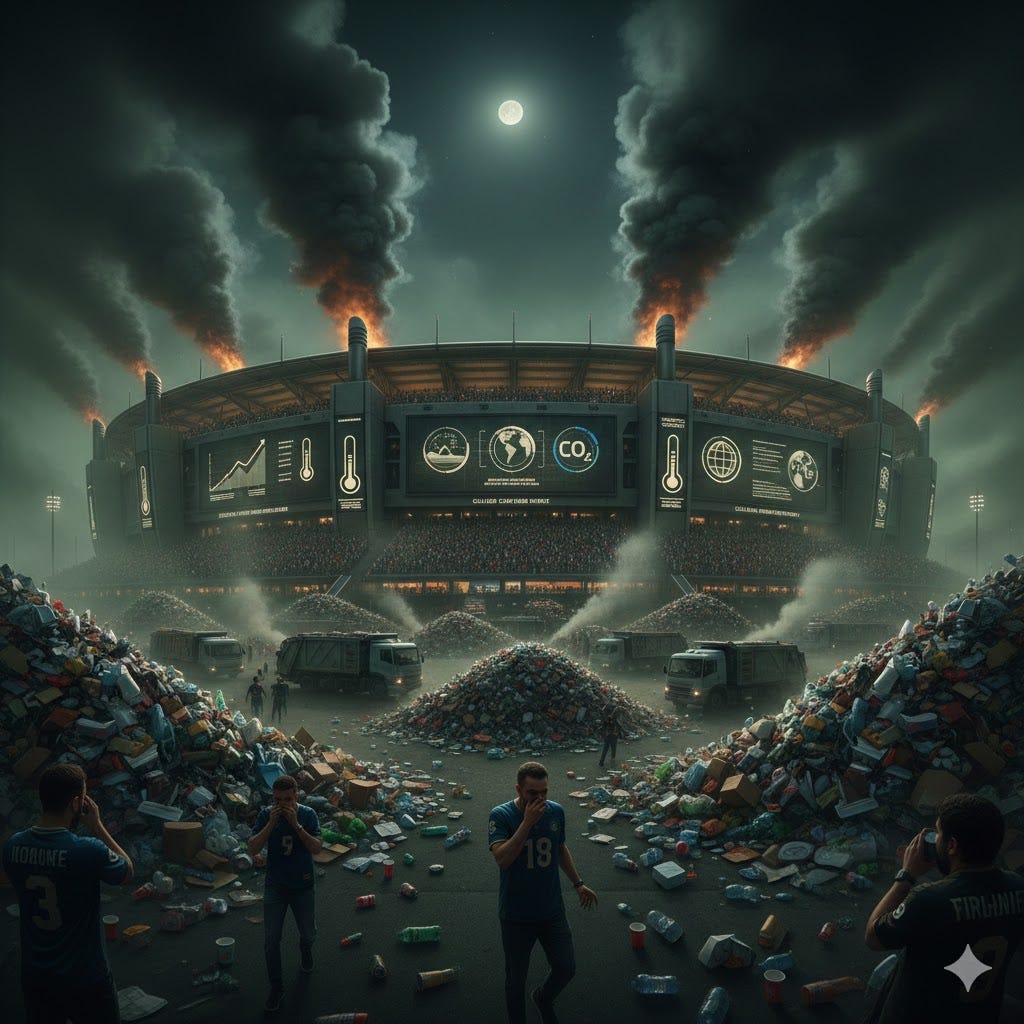
Art direction by Yaofeng Zhao | Illustration generated by Google Gemini
AI disclosure: The summary, FAQ and multimedia for this project were created using a Notebook LM analysis of the story text.
Summary: Sports significantly contribute to climate change through travel emissions, energy use and waste. Events like the FIFA World Cup and Winter Olympics face increasing environmental scrutiny. Climate change also endangers athletes with extreme heat and flooding. Sport organizations, venues, athletes and brands pursue sustainability efforts, though greenwashing concerns remain.
Sports are an integral part of culture worldwide, becoming a major part of people’s daily lives as entertainment. However, sports events arenot immune to impacting climate change. They leave a carbon footprint from the gas emissions associated with traveling and waste disposal at stadiums, data from various sources show.
Moreover, certain sports and events, including the Winter Olympics, are threatened by climate change, which remains a major concern. Due to this, sustainability in sports has become a new top priority to ensure a greener future, involving multifaceted efforts from both organizations and athletes.
Sports leave a large carbon footprint in many ways, according to studies. Team travel involves flying between cities — often on private jets — for their matches and then riding on coach buses from airports and hotels to stadiums for the games. Global sporting events, such as the FIFA World Cup, are notorious for producing large amounts of carbon dioxide.
According to FIFA, the 2022 Qatar World Cup generated 3.8 tons of carbon emissions, with 2.2 million of these coming from transportation. FIFA’s carbon emissions are expected to increase in its upcoming editions, including the 2026 World Cup, which will be hosted in the US, Canada and Mexico.
UIC Civil, Materials and Environmental Engineering Professor Aslihan Karatas agreed that the 2026 World Cup could emit millions of carbon dioxide into the atmosphere.
“It’s going to create a lot of carbon emissions, just maybe because of the travel,” she said.
Karatas added that North America has a different transportation system compared to previous hosts.
“Public transportation is not well developed, so people cannot utilize it for going from one place to another by train,” she said when explaining why FIFA World Cup travel tends to generate high emissions. “It’s not feasible at all.
“The whole culture, whole country is relying on the cars and the planes,” Karatas said,noting North America’s reliance on private transportation. “That’s how it’s been established.”
Likewise, Formula 1 racing is also a global sport known for carbon emissions. In 2022, the organization emitted 223k tons into the atmosphere. Logistics made up most of F1’s emissions, accounting for more than 100k tons, according to Ecollective.
Being a global sport, this involves transporting not only drivers and staff, but also cars from one race to another held anywhere in the world.
Not only is travel a significant contributor to carbon emissions, but energy consumption from sports venues is also a substantial contributor to this issue. For example, AT&T Stadium, home of the Dallas Cowboys, uses approximately 51 megawatts of electricity per day, primarily generated from lighting, equipment, machinery, and environmental control systems.
However, according to Scout Cities, this is still less than the amount of electricity generated by Intel’s Fab 42 manufacturing facility, located in Chandler, Arizona, which uses up to 2,400 megawatts a day. The Wall Street Journal claimed that on a typical game day, the stadium generates 10 megawatts, which is more than Liberia’s entire national power grid.
This example demonstrates that a single stadium generates a substantial amount of electricity; however, other locations can still produce more than a sports venue does. Stadiums also generate significant amounts of waste from sporting events.
NFL stadiums produce between 30,000 and 50,000 pounds of waste volume, depending on seat capacity. This is in stark contrast to high school stadiums, which typically have fewer seats and fewer fans in attendance, thus generating less waste than professional sports venues.
Much of the waste originates from consumables such as food, drinks, packaging, containers, cups, promotional materials and other items. On average, a fan disposes of 1.5 lbs of waste at a sporting event, according to Prime Dumpster, Inc. This demonstrates that capacity and attendance can significantly impact the amount of garbage generated by a sporting event.
In addition to the carbon footprint sports produce, climate change has become a major threat to sports. The Winter Olympics have been particularly vulnerable to this problem, and among the measures taken to address it is the use of artificial snow. Several Winter Olympics editions have used it, beginning with the 1980 Lake Placid Olympics.
Since the 2010 Vancouver Winter Olympics, its use has increased. Approximately 80% of the snow used during the 2014 Sochi Winter Olympics was artificial, and similarly, the 2018 edition in PyeongChang, South Korea, featured 98% synthetic snow.
Additionally, the use of artificial snow has been questioned by environmentalists. They warn that the process of manufacturing it involves heavy use of water, which they say can damage local ecosystems, and the use of fossil fuel energy to power the snow machines. The Winter Olympics isn’t the only winter sporting event using snow machines; many ski resorts worldwide also use them.
This issue highlights that, despite the use of snow machines being an effort employed by winter sports to address climate change, it still presents its own environmental challenges. Like winter and summer sports are also vulnerable to the effects of climate change.
Many summer sports, including soccer, football, baseball, and tennis are primarily played outdoors. This puts athletes at risk of heat exhaustion if they play in scorching heat. Due to these conditions, many sports events have been postponed or delayed.
The 2022 FIFA World Cup took place in Qatar, which is known for its desert hot climate. Because of its climate, FIFA held it in November and December of that year instead of the traditional June and July,a move that UIC Earth and Environmental Sciences professor Andrew Malone said is a smart one.
“I think adaptive strategies, such as changing the season, changing what month seasons are played in, could be one strategy,” he said. “If you’re having more dangerously hot summers, then starting your seasons later in the year might be one way to do that.”
Although moving outdoor sporting events to cooler weather days has been an effective measure to address the heat, athletes have still suffered from heat exhaustion, with some cases being even fatal.
Natalie Kozlowski, the assistant athletic director at Morton High School District 201, said that Illinois high schools follow IHSA protocol for extreme heat.
“There is an IHSA protocol for sports in extreme heat, and whether breaks need to be given,” she said. “Athletic trainers are the ones who check that and reach out to coaches. This happened last year and some coaches, like cross country, decided to do practice in [the morning] to avoid extreme heat.”
Besides amateur and interscholastic athletes, the risk of heat exhaustion extends even to professional athletes. In 2001, Minnesota Vikings player Korey Stringer died from heat stroke he suffered during training camp practice that took place in extremely hot weather.
In the aftermath of his death, the NFL implemented many changes to prevent heat stroke deaths by making outdoor practices safer and creating protocols to be activated in the event of heat exhaustion. Years later, the Korey Stringer Institute was founded in partnership between his family, the NFL, Gatorade, and the University of Connecticut, which aims to address heat exhaustion in sports.
The player hospitalizations and deaths from heat exhaustion suffered during sporting practices and events prove that extreme heat has become a major threat to sports and athletes’ health and safety. Extreme heat isn’t the only climate change effect that is affecting sports
During the spring and summer, thunderstorms are common. With the rise of climate change, thunderstorms have become more torrential. Flooding is one of the storm’s major threats, and it has increased due to climate change as well.
This has also posed a significant threat to outdoor sports, leading to the postponement of some events as a result. In August 2025, multiple high school football games in Charleston County, South Carolina, were canceled due to flash floods caused by severe thunderstorms occurring in the county.
In November 2025, five Copa del Rey games were postponed due to deadly floods in the Spanish region of Valencia and were rescheduled for later dates. The same floods also caused Real Madrid vs. Valencia, scheduled for Saturday, Nov. 1, to be postponed.
Hurricanes, which often produce flooding, can also affect sports. The New Orleans Saints played their 2005 season in temporary venues due to Hurricane Katrina, which damaged their home venue, the Superdome, requiring a year of repairs.
Likewise, the New Orleans Hornets temporarily relocated to Oklahoma City for their 2005–06 and 2006–07 seasons, as their arena underwent repairs from hurricane damage.
Malone noted that New Orleans’ vulnerability to hurricanes and rising ocean levels has prompted measures to prevent a devastating flood from occurring in the future.
“Much of the city today is below the current water levels of the Mississippi River,” he said. “In the short term, we can build levees and retaining walls to keep the water back.”
He said he also believes that the rising sea levels threatening New Orleans could cause its sports teams to consider relocation in the future.
“There may need to be relocations of the cities that are deemed too risky to live in,” Malone said. “If that happens to be where a sports stadium is or a practice field is, that would then require the city and/or those teams to invest the money to relocate.”
The effects of climate change, such as extreme heat and severe floods, have proven to be major threats to sports, as exemplified by the examples explained earlier.
In the face of climate change, some professional sports teams have addressed the issue by building greener venues. Several NFL, NBA, MLB and NHL stadiums have been LEED-certified, a rating system created by the U.S. Green Building Council, an organization dedicated to building environmentally friendly structures.
One example isSoldier Field, home to the NFL’s Chicago Bears. Following its 2002–03 reconstruction, it was transformed into a LEED-certified venue, making it the first NFL venue to achieve that certification. The stadium’s rating has since been upgraded to Gold, one of the system’s highest ratings. Its greener practices include recycling programs, a free EV parking lot, and LED lighting.
Several other NFL venues have followed suit since then. Several college sports venues have also been constructed with environmental sustainability in mind. University of North Texas’ football stadium, DATCU Stadium, became the first newly built NCAA football stadium to achieve the LEED Platinum rating, the highest LEED certification a building can achieve.
Among the venue’s greener features is its wind turbines that generate electricity for the stadium. It was also built partially using recyclable materials, according to North Texas. These examples demonstrate that a greener venue is possible, and a LEED rating can verify its green status.
Green spectatorship is a concept that aims to make the experience of attending a sporting event more environmentally friendly, including the use of public transportation, as well as reusable and recyclable materials. Climate Pledge Arena, home of the NHL’s Seattle Kraken, underwent renovations in 2021 to transform the six-decade-old arena into a green venue.
In addition to its environmentally friendly features, the company also aims to achieve zero waste and provide a greener fan experience. To provide such an experience, the arena utilizes solar panels to power itself, offers recycling programs, provides free public transit, features a cistern that collects all rainwater to create the NHL ice, and boasts energy-efficient bathrooms and showers. This shows that it is possible for a fan to be a green spectator, and the Climate Pledge Arena has set a model that other stadiums could follow.
The International Olympic Committee (IOC) and FIFA have responded to the need for sustainability by demonstrating how they could make their games greener for the future. The IOC has outlined its plan to make environmental protection a priority, with its webpage detailing its courses of action to make its events greener.
FIFA has also attempted to address sustainability by creating a document detailing its plan to make its games sustainable for the future. Despite its sustainability plans, the federation continues to be criticized for greenwashing, a practice in which an organization uses deceptive public relations and marketing tactics to make its policies appear to be eco-friendly. This criticism was reinforced when environmental observers found that FIFA had falsified their carbon neutrality claims for the 2022 Qatar World Cup.
Like FIFA, the IOC has also faced criticism for greenwashing. An article by the Scientific American listed its practices in the 2024 Paris Olympics that contradicted its sustainability plan by mentioning, but not limited to, travel emissions and the use of concrete for venue construction.
The sustainability initiatives by the IOC and FIFA have attempted to address their environmental plans, but criticism from environmentalists, along with their evidence to support it, has raised concerns and questions regarding the validity of their visions.
These athletes have shown to be voices leading the movement for greener solutions through business ventures and advocacy, bringing sports and environmentalism together.
Additionally, sports clubs have supported greener causes. Apart from building eco-friendly venues, clubs have also supported conservation efforts and organized environmental activities.
There have also been league efforts to promote environmental efforts. The MLB, for instance, has a list of club initiatives detailing how teams have committed to creating a sustainable environment.
Art direction by Yaofeng Zhao | Illustration generated by Google Gemini
An English soccer club, the Forest Green Rovers, has made it its mission to make its games and fan experiences greener. Among its efforts have been selling vegan concessions exclusively, using reusable bottles and encouraging carbon-free travel, such as biking and driving electric vehicles. Additionally, its stadium uses LED lighting, battery-powered pitch displays and scoreboards, and other renewable sources to power it.
Wearing uniforms manufactured from recycled materials has also become a new way for teams to become sustainable. In 2018, the Miami Hurricanes began wearing uniforms and cleats made with waste recovered from the ocean. In 2021, NHL teams also started adopting uniforms produced from recycled content.
These various efforts, ranging from switching to uniforms made of eco-friendly materials to partnering with wildlife and climate organizations, have shown that sports clubs are participating in an endeavor to promote a greener environment.
Sports apparel companies have also stepped up to confronting climate change by manufacturing their products from recycled materials.
The fashion industry has contributed to 8–10% of global carbon emissions, mainly from production. Many sports apparel items are made from polyester, which is generally manufactured from fossil fuels, therefore making it unsustainable and non-recyclable.
Patagonia, an outdoor sports apparel brand, produces its items primarily from eco-friendly materials. On the company’s environmental responsibility page, it lists the recycled materials used in production. In addition, it has expanded its sustainability by participating in various environmental justice programs.
Adidas and Patagonia have demonstrated that they are tackling climate change by producing greener products, though the sports apparel industry still has a long way to go to address its environmental impact.
Overall, the relationship between sports and the environment is at a turning point. Sports can be a contributor and also can be a vulnerable victim of climate change.
The immense carbon footprint generated by events such as the FIFA World Cup and Formula 1, the waste production, and energy consumption at stadiums, all of these reflect the impact on the environment.
Additionally, weather events such as extreme heat and flooding, which are both linked to climate change, have also jeopardized sporting events and player health and safety.
In the face of climate change, sports organizations, leagues, clubs, athletes, and apparel brands have all played various roles in addressing the issue and attempting to provide solutions to ensure a greener future.
Only time will tell if their efforts will pay off and effectively help the environment. It is still up to them to continue to find other solutions, as the complex relationship between sports and the environment deepens.
“So potentially, partnerships with sport leagues and companies can be a cool opportunity for sports teams to contribute to a greener electricity future,” Malone said.
——
FAQ: Sports and the Environment
Q: How significant is the carbon footprint left by the sports industry?
A: Sports leave a large carbon footprint primarily through gas emissions associated with traveling and waste disposal. Team travel often involves flying on private jets and riding coach buses. Global events are notorious emitters; the 2022 Qatar World Cup generated 3.8 tons of carbon emissions, with 2.2 million tons coming solely from transportation. Environmental researchers believe the 2026 World Cup could generate up to 9 million tons of carbon emissions. Energy consumption from sports venues is also substantial; for instance, AT&T Stadium uses approximately 51 megawatts of electricity per day. Additionally, NFL stadiums can produce between 30,000 to 50,000 pounds of waste during an event
.
Q: How does climate change threaten sporting events and athlete safety?
A: Climate change threatens sports in several ways. Winter sports, like the Winter Olympics, are vulnerable, often relying on artificial snow (e.g., 100% artificial snow was used in the 2022 Beijing Games). The process of manufacturing artificial snow has been questioned by environmentalists due to heavy water use and the need for fossil fuel energy to power the machines. For summer sports, extreme heat puts athletes at risk of heat exhaustion, leading to event postponements or delays. Between 1992 and 2024, 58 high school football players died from heat stroke. Furthermore, increasing flooding and hurricanes have caused the cancellation or postponement of games and can damage venues, sometimes prompting consideration for team relocation
.
Q: What sustainability efforts are being implemented in the sports world?
A: Sustainability has become a top priority, involving multifaceted efforts from organizations and athletes. Teams are building greener venues that are LEED-certified, such as Soldier Field (Gold rating) and DATCU Stadium (Platinum rating). These initiatives include recycling programs, the use of renewable energy (like wind turbines or solar panels), and promoting green spectatorship by offering free public transit. Athletes like Serena Williams and soccer great Megan Rapinoe are advocating for environmental causes through business ventures and platforms. Apparel companies are also addressing the issue by manufacturing products from recycled materials, sometimes using waste recovered from the ocean.
When the Indiana Fever playerSophie Cunningham took the court on Aug. 5 to play against the Phoenix Mercury, she was unaware of what explicit event was coming and her teammates’ way. Action stopped on the court when a brightly colored dildo was tossed there, making contact with Cunningham before it was kicked aside by Kelsey Plum.
This, however, was not an isolated incident, as throughout the 2025 season. multiple sex toys were thrown onto WNBA courts by people in the crowd. This act and object of choice was not random, as the WNBA is known for its heightened number of out lesbian and queer players. The individuals who threw them knowingly chose to throw an item that draws attention to out players and sexualizes their orientations as lesbians and members of the queer community.
Despite the inappropriate nature of this act, it highlights the inherent connection between the women’s athletics and queer visibility. Members of the queer community have historically participated in sports, including up to the professional level. Billie Jean King, Martina Navratilova and Sue Bird are among the trailblazing lesbians to bravely come out and shift the entire perception of lesbians in athletics. These male-dominated sports create a space for subversive forms of femininity, such as lesbianism, that detach from traditional gender roles.
According to the National Library of Medicine, women are proven to be better at providing social support to each other and providing psychological and social benefits within relationships. Sports teams are notoriously tight-knit, and a lot of trust is involved in successful teamwork. Similarly, people who have similar interests, or even sexual orientations, are typically attracted to each other, both romantically and amicably.
Equivalently, marginalized groups typically band together to create a collective strength and find support networks to work against the systemic advantages they face, according to Socio.Health. One group that has been marginalized throughout history is the LGBTQ+ community, and there is an instant connection and understanding amongst queer folk because only those who have faced similar challenges to the LGBTQ+ community can understand their complex feelings.
Given these facts, it only makes sense for queer women to flock together in an athletic setting, and when you add the possibility of queer romantic attraction and friendship connections, the correlation between the women’s athletic space and queer visibility becomes clear.
There is an evident influx of lesbian and queer players and personnel in women’s sports, and this is an investigation into the origins of queerness in women’s sports, why this connection may have occurred, and how the LGBTQ+ community is currently perceived in association with women’s sports.
Female athletes are commonly stereotyped to be a part of the LGBTQ+ community. Ava Kindopp, a UCLA women’s rugby player, said that people have assumed she is gay just because she plays rugby. However, as history proves, stereotypes are often rooted in truths. Kindopp said, “The majority of my team are out or openly lesbian, gay, or queer.” Conversely, a man would rarely be assumed to be gay because he does or doesn’t play sports.
Sports environments are spaces where queer women, out or not, can go to find other queer women because of these established stereotypes.
For reference, almost 30% of the current WNBA league players and over 15% of Professional Rugby league players are out as Lesbian or Queer, according to Write Through the Night. These statistics have only been increasing since the inception of these leagues, and as the worldwide acceptance of the LGBTQ+ community rises.
This influx phenomenon, however, is not found in every sport played by women. There is specific criteria that draws lesbian and queer athletes together to play certain sports.
According to UIC Sociology Associate Professor Pamela A. Popielarz, sports carry guidelines known as the constructions of gender that dictate what is appropriate for men and women to do. Being lesbian or queer as a woman is extremely defiant against these constructions of gender placed upon women.
Women are expected to play a feminine role in their romantic relationships, but when the relationship is made up of two women, the “balance” in a relationship is completely thrown off. By being lesbian or queer, these individuals can experience life and explore relationships on any side of the spectrum from femininity to masculinity, rather than having to stick to the feminine side. It is more common to see a lesbian or queer woman dressing masculinely than a straight woman because they have the space to explore masculinity without fear of repelling a male romantic interest.
Physical displays of strength and agility, such as soccer, basketball, and rugby, were historically played by men. Other sports where beauty and aesthetics are valued, such as gymnastics and figure skating, are historically played by women. Queer athletes, such as Kindopp, are drawn to the historically male-dominated sports, as such sports are, according to Kindopp in an interview, “for all types of athletes,” and she finds that her own sport, rugby, “supports bigger female athletes.”
Men societally have fewer guidelines when it comes to body type and size, therefore, the sports men play have more room for body inclusivity. On the other hand, our society only values women who are skinny and conventionally attractive, therefore, the sports women are “assigned” to play gymnastics and figure skating, and have strict expectations for athletes’ physical appearance. Queer athletes, however, in another act of subversion, can detach from such expectations and seek enjoyment outside of such traditionally feminine sports.
Such perceivably “unfeminine” sports provide queer athletes with benefits and positive experiences they may not have ever found otherwise. For instance, many queer or lesbian individuals feel most comfortable around those of their same sex and feel discomfort around those of the opposite sex. Across the board, sports are a homosocial environment, providing recreation for those who prefer to spend their time with peers of their same sex, and many of those people are also a part of the queer community.
Similarly, participation in such “masculine” sports can provide a protection against homophobia for those queer women who may lie on the masculine side of the spectrum, but are not “out.” Rather than having to hide their masculinity, they can rationalize it by stating they participate in a sport, but are not gay, as that is a stereotype, but not every female athlete is gay. In hopes, however, these “closeted” women would find empowerment and acceptance in the queer space that is women’s sports and work toward living their LGBTQ+ truths.
Acceptance and community are key tenets of female athletics, especially among queer athletes, and they differ between each sport. Specifically, women’s rugby is a space where queer and lesbian players are especially visible. According to the Journal of Homosexuality, a well-constructed rugby team relies on a diverse skill set, fulfilling each of the unique 15 on-field positions. Each position requires each player to be strong or tall, or fast, therefore, body inclusivity is built into the sport. Likewise, the rugby uniform worn by players includes a T-shirt jersey and athletic shorts, which can be cuffed and personalized to each player’s body comfort.
“I think there is a stark difference between LGBTQ+ culture in rugby versus women’s sports as a whole,” Kindopp said. “I played sports my whole life, including softball, volleyball, basketball, water polo, and tennis, and I did not feel supported on those teams.
“As a lesbian athlete playing rugby, I feel genuinely uplifted, not only by my own team but by the broader rugby community. I also think the need for all female body types, both big and small, on the rugby pitch, fosters a more inclusive and diverse community of women. Together, the LGBTQ+ support and diversity within the sport are what make rugby culture uniquely inclusive.”
Physicality is a crucial aspect of rugby, and a great deal of trust is involved between players. Physical release of stress is also common among members of the queer community, as numerous societal pressures are working against them. It is incredibly common for people to struggle to express and release their stress with just words, therefore, they search for other outlets.
Contact sports like rugby create a space for physical aggression in a safe and regulated manner, whilst providing players with a community of peers who feel similarly in regard to stress relief.
This visibility for and inclusion of the queer community was not always so prevalent in the women’s athletic space, however.
King, the prolific former American tennis player and current advocate for gender equality, was the first prominent female athlete to come out as gay. According to the New York Post, throughout King’s career and prior to her outing, she simultaneously upheld her heterosexual cover and preserved her queer identity in a balancing act. King was married to a man and was pregnant in 1971, but she terminated that pregnancy after she explained to a panel of doctors why she needed the procedure.
She faced sexism on and off the court, and by the late 70s, even though King knew she was a lesbian, she denied it in a Playboy interview. Eventually, in 1981, King’s former secretary and lover outed her in a lawsuit. This threw an immediate wrench into King’s career, and she lost almost 1 million dollars in sponsorships and endorsements overnight. Nevertheless, King did not let this setback ruin her career. At first, she denied the entire affair, but she ultimately confirmed it at a press conference with her husband by her side. She continued to play tennis as an out lesbian, eventually divorced her husband, and fell in love with her doubles partner.
The same year that King was sued and outed by her former lover, a fellow tennis professional, Martina Navratilova came out to a reporter as lesbian, and that reporter published the information in the newspaper before she was ready. According to the Irish Times, Navratilova immediately embraced this and was seen with girlfriends in public shortly after the article was published.
Decades later, in 2002, when WBNA star Bird was drafted, she was living her personal life as a gay woman, having girlfriends and attending Pride events. Yet, when she entered the spotlight, Bird was forced back into the closet by her agents as the WNBA wanted to peddle her as the straight girl next door. Her image as a queer woman was not marketable at this time, so for her 21 years in the league, she lived publicly as a straight woman. Deep fear was instilled in Bird that if she came out, her career would be over. Thankfully, in 2017, alongside her new romantic partner and fellow queer professional female athlete, Megan Rapinoe, Bird made her way out of the closet, according to Out Sports.
Given these examples, it is unmistakable how queerness was previously handled within the women’s professional athletic world. These athletes, despite their incredible talents, were devalued due to their sexual orientation. They were forced, either by direct external oppressors or general societal pressures, to live a heterosexual lie, and when someone did get wind of their private lives, it was oftentimes exploited.
Responsively, as our society shifts towards acceptance of the queer community, industries follow suit. There is a reason why Bird’s coming out was delayed until 2017, and that is because our society was in a more accepting place for her and her sexual orientation than when she first entered the public eye.
As Popielarz put it, there have been LGBTQ+ players in sports all along, and the current “influx” is not necessarily due to a numerical increase, but an increase in visibility.
In 2025, there are still stereotypes and assumptions regarding female athletes’ possible queer identities, however, rather than speculation being malicious, fans actually desire their favorite female professional athletes to be lesbians. In acting as a catalyst, social media is a marketplace for fans to romantically pair teammates together and sexualize professional athletes. In lieu of athletes living in fear of being outed as queer, now they are pressured to come out as queer or strongly assumed to be queer.
One league that has drastically increased in popularity over recent years is the WNBA, especially in relation to its queer players. After the 2024 draft, the league garnered mainstream national attention during the season and was talked about more than ever before on the internet. This trend had increased since then, bleeding into the 2025 WNBA draft and season.
For instance, Dallas Wings player Paige Bueckers gained a lot of social media attention after she was the first overall pick in the 2025 WNBA draft. As soon as she was drafted, assumptions arose surrounding her sexuality. Outside of the court, Bueckers appeared in masculine-inspired outfits, and fans thought they saw chemistry between Bueckers and her former UConn teammate and long-time friend Azzi Fudd on social media.
Conjecture blew its top after Fudd posted on social media with a phone case that said “Paige Bueckers’ Girlfriend.” According to Pride, signs of their relationship only increased in frequency after this, and fans, especially queer fans, were supportive the whole way. Eventually, a fan approached Bueckers with a fan poster that said, “Azzi Fudd’s girlfriend sign here,” and Bueckers signed. Since their relationship was confirmed on both ends, the #Pazzi on social media is full of fan edits and content in absolute support of their relationship.
In an opposite instance, during the Paris Olympics, Ilona Maher, a rugby player on Team USA, began to go viral on social media. She posted about her experiences in the Olympic Village, and her charisma drew audiences in. Maher and her teammates ended up securing the bronze medal at the 2024 Olympics, and with that came even more attention on her. As formerly established, rugby is a particularly queer sport for its inherent inclusivity and physicality, therefore, many speculated that Maher was queer, as are many of her fellow teammates, such as Alev Kelter and Katheryn Treder. In a shock to many, Maher consistently posted to social media, alerting her queer fans that she is heterosexual, but jokingly wishes she weren’t. If you look into the comment section under many of Maher’s posts over a year after her initial rise to fame, you will still find numerous comments of queer women lusting over Maher.
The journey from King’s public outing to Bueckers’ public relationship with Fudd represents both a triumph and a transformation of burden for queer women athletes. Whereas retired queer athletes such as King were forced into silence regarding their sexuality, modern athletes, including Fudd and Bueckers, are forced to declare it. The structural reasons that draw queer women to athletics remain unchanged. The rejection of restrictive femininity, the draw of physical spaces built for body diversity, and the homosocial environment that offers comfort and community have always been evident in women’s sports.
Yet, as society’s acceptance grows, so too does the question of what lies beyond visibility. Can we progress even further to the point where no athlete, male or female, gay or straight, has to declare their sexual orientation simply for the fact that they are in the public eye, or will women’s sports remain inherently intertwined with queer identity precisely because these spaces offer what society at large still struggles to provide? The answer likely lies somewhere in between, in a future where queer women athletes are neither forced into shadows nor pulled into spotlights, but simply allowed to play.
By Solomon Gilliam and Nicole Ferdinardo • December 10th, 2025
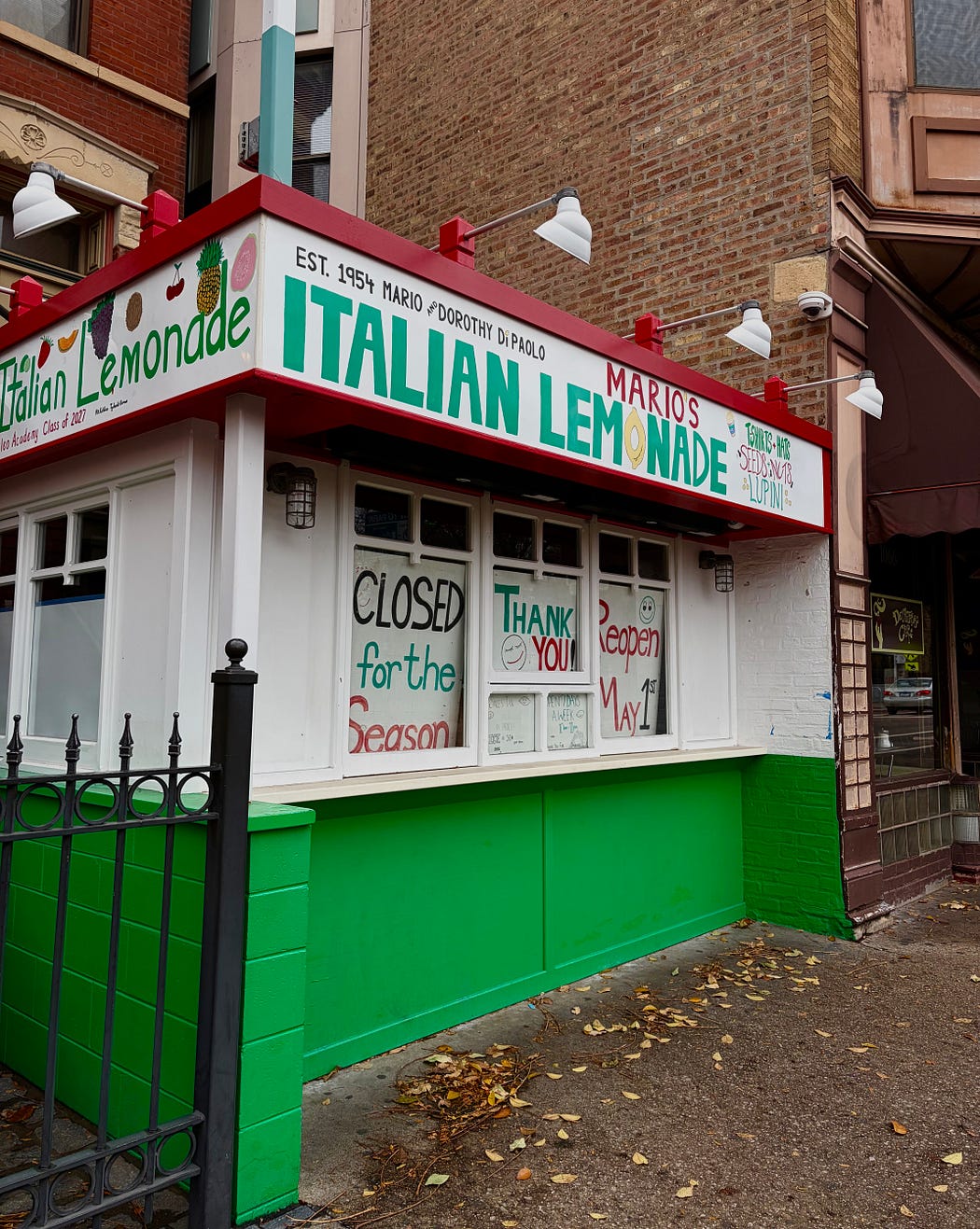
The longtime popular Mario’s Lemonade Stand in Little Italy. (Photo/Nicole Ferdinardo)
Little Italy’s Taylor Street was once defined by its sense of family, a close Italian-American community where everyone knew everyone. However, with shifting demographics, longtimeItalian businesses closing and new trendy diverse spots moving in, residents and workers are asking if the name Little Italy still fits.
“I used to deliver groceries to the old-timers, they would wait for me with cookies or other baked goods,” said Angelica Perez, a 31-year employee of Fontano’s Subs. She said she considers Little Italy her second home.
“Everyone helped everyone,” she said.
Little Italy wasn’t just a place to eat Italian food, it was a community built on routine, loyalty and deep personal connections. Not only did neighbors live side-by-side, but they actively participated in one another’s lives.
“Everybody watched everybody, like ‘oh, do you need something? Let me help you,’” Perez said.
“We didn’t sell coffee, but because it was the neighborhood, the owner used to make it in the back, and I used to come and bring it to them.”
The neighborhood operated like a big family. People regularly did things for each other out of kindness, which created a unique rhythm to daily life; it gave the neighborhood its character just as much as the food.
“When I started 31 years ago, the neighborhood was a lot of old timers, [they were] very nice people,” Perez said.
But the Little Italy of today looks different. Over the past few decades, Little Italy has faced changes due to several factors.
Curtis Winkle, University of Illinois Chicago Urban Planning and Policy Professor, has lived in Little Italy for 10 years. He said that when UIC was built, it “decimated part of the neighborhood.”
Winkle said that Little Italy’s changes resemble the ecology theory, “invasion and succession,” described by the Chicago School of Urban Ecology, which is when one group gradually replaces another.
Winkle described one conflict that may have reflected the changing demographics of the area: the removal of the Christopher Columbus statue in Chicago’s Arrigo Park. Following the demonstrations related to George Floyd’s death in 2020, the city decided to remove the statue.
Many activists viewed the statue as a symbol of oppression. However, some Italian Americans and residents of Little Italy viewed it as a part of their heritage and connection to America. As a result, counterprotests took place advocating for the return of the statue. Winkle even reported seeing the Proud Boys at one counter protest.
“I think that [the statue removal] better represents a student’s way of looking at the world, versus an Italian neighbor’s way,” Winkle said. The dispute is another representation of how the neighborhood now accommodates a wider demographic, a contrast that many residents have noticed firsthand.
Said Perez,“Now, I think it’s more university. A lot of the old-timers are gone … they passed. They were very elderly when I came around.”
Times have changed in the Chicago neighborhood, including shifting demographics of people and businesses, prices and population.
Today, the neighborhood faces a dilemma. UIC’s growing student population shapes more of the foot traffic, and new restaurants offer tastes that are far outside of the area’s historic identity.
As the original traditions fade, and new trends continue to pop up, residents and workers face the question: What does Little Italy become when the traditions that built it no longer hold the spotlight of the area?
(Shot by: Nicole Ferdinardo)
Historically, the Taylor Street corridor was the heart of Chicago’s Italian immigrant community. The city’s foreign-born Italian population peaked in 1930 at 73,960, with Little Italy serving as a central place of settlement, according to the Encyclopedia of Chicago. For ages, the area was filled with Italian grocery stores, bakeries, and restaurants owned by families who had lived there for generations.
But as Italian families moved into the suburbs in the late 20th century, and as UIC expanded its campus, the community’s identity began to shift. Today, according to 2020 census data, the Little Italy area (60607) is 53% White, 23% Asian, 12% Black, 9% Latino, and less than 1% American Indian or Pacific Islander. In just one generation, Little Italy has shifted from being predominantly Italian to one of the more diverse neighborhoods of Chicago.
Winkle said that these shifts have also changed the way people refer to the area. He hears people refer to it as both University Village and Little Italy.
“Losing some key institutions like Rosebud and others gets people to reframe it,” Winkle said.
Still, many residents and workers disagree on what that means for the area’s cultural identity. The longtime Fontano’s worker, Perez, admitted that the name “Little Italy” may not reflect the current population anymore.
Still, she enjoys all of the university students who eat there. “I see their faces every day, I already know them by their name or what they like.”
There is still a strong community in Little Italy, but it looks different than before.
Alongside traditional family-run Italian restaurants, Little Italy now features new modern and cultured spots. Some spots in particular include Two Shades Cafe, a modern coffee shop at 1152 W. Taylor St., Kurimu, an Asian-influenced dessert shop at 1159 W. Taylor St., and Taylor’s Tacos, a black-owned taqueria at 1512 W Taylor St.
These new and diverse spots cater to young residents and students. While these businesses bring in fresh energy and new crowds, their growth also raises concerns among longtime residents who feel that the neighborhood’s Italian culture may be becoming diluted.
These additions reflect the neighborhood’s evolution; however, they also contribute to the ongoing debate about whether the “Little Italy” name truly represents the modern-day community.
“There are a lot of restaurants that are no longer here, that are being replaced by different cultural restaurants,” said Dominican University student Vedrana Gotovac, who grew up visiting her grandparents in Little Italy. She said that it has changed since she was younger.
“One restaurant that I remember specifically was Leona’s,” Gotovac said of the famous Italian restaurant. “Iwould go there all the time when I was younger with my grandparents, and it is no longer here in Little Italy.”
Vedrana said she believes that the neighborhood is losing a lot of its tradition.
“I don’t know if I would call it Little Italy, cause, you know, it’s changed, right? Change is good sometimes,” Perez said.
By Adam Belmares and Yaofeng Zhao • December 10th, 2025
Before the COVID-19 pandemic, Chicago’s Chinatown served as a vibrant cultural and economic hub for the city’s Chinese community.
Post-pandemic, the neighborhood experienced a sharp decline in foot traffic, resulting in business closures, economic downturn and social tensions. Local families, business owners and visitors were directly impacted by the local government-implemented shutdowns.
Wei Keng Zhao, who has lived in Chinatown for more than two decades, experienced the effects of the shutdowns of local restaurants and businesses in a community that relies on tourism to thrive financially.
Along with the shutdown of local businesses came more African American and Latinos residents moving into the community.
“Before the pandemic, there wasn’t a lot of [diversity] in Chinatown, mostly just Chinese people in Chinatown and a few restaurants,” Zhao said. “When COVID-19 hit, everything changed. When the pandemic finally ended, the impression of Chinatown was different and many Americans came to Chinatown to try Chinese food.”
Across the country, the pandemic has caused many Chinatown communities to undergo recovery from economic effects and lack of government funding to help businesses back on their feet.
In 2019, there were 950 stores, restaurants or offices in San Francisco’s Chinatown. Since then, more than 200 of those businesses have closed permanently or temporarily during the peak of the pandemic.
As of 2024, there are now roughly 700 businesses and offices active in San Francisco’s Chinatown.
Located near the Red Line stop at Cermak and the Archer/Wentworth area, Chinatown is widely-known for its delicious restaurants, specialty shops and colorful festivals that draw locals from all across the Chicagoland area along with tourists that prioritized a trip to the historic neighborhood.
However, the arrival of the pandemic dramatically changed things. Five years after the COVID-19 crisis, the effects of the global pandemic still impact Chinatown, resulting in an increase in social tension and economic setbacks.
As the neighborhood slowly recovers, long-term implications from the pandemic continues to influence how the community rebuilds and redefines its identity in a changing urban landscape.
Pre-Pandemic Chinatown
Before the pandemic disrupted the daily life of Chinatown residents and business owners, the area thrived as a hub of Chinese culture, commerce and community life.
A census reported by the Chicago Sun-Times in 2020 found that Asian Americans were the fastest-growing racial or ethnic group in Chicago. The Asian American population across the city saw an increase of about 31 percent from 2010 to 2020, highlighting that the area served as a place of belonging and identity for many of these Chinese immigrants.
The increase of Chinese immigrants foreshadowed the increase of social networks among Chinatown residents and strengthening the community’s support systems.
Despite other Chinatowns across the nation falling into an endangered state, such as the case in Philadelphia and Seattle, one of Chicago’s most popular tourist destinations continued to grow at a record-breaking pace.
The convenient route to the Red Line Cermak-Chinatown station allowed the area to be easily accessible to locals across the city to attend events hosted in the area after a long work shift and after classes for university students during weekdays.
The route served as a hot spot for tourists on the weekend, resulting in high attendance in Chinese traditional celebrations.
In March, 2020, Governor J.B. Pritzker announced a statewidemandate closingindoor dining services to help slow down the spread of COVID-19.
Multimedia created by Notebook LM
Impact of COVID-19
The arrival of the COVID-19 pandemic brought devastating consequences to Chinatown’s economy and social fabric.
Health concerns and lockdowns disrupted local businesses, misinformation linking the virus to China fueled anti-Asian racism, and many tourists avoided Chinatown, labeling it a “ghost town.”
A combination of the lack of knowledge about the virus and the spread of misinformation in the media enforced harmful stereotypes towards Chinese people across the country, leading to hate crimes and labeling the cause of the virus towards the Chinese population.
Darryl Tom, principal officer of the Chicago Chinatown Community Foundation, along with many Chinatown organizations, were devastated by the loss of foot-traffic and pausing local events, viewing it as a threat to the foundation of Chinatown culture.
A closed Chinatown market. (Photo courtesy Morris Lum)
“During the pandemic, a lot of businesses were closed because of the economy,” he said. “Many festivals were cancelled or pushed back like the Lunar Years, Dragon Boat Festival, Chinatown Summer Fair, etc.”
Festive cultural events such as the annual Lunar New Year parade, Dragon Boat Race, Taste of Chinatown, and Mid-Autumn Festival were all halted for an extended period of time due to the shutdowns of local vendors and well-established dine-in restaurants.
The pausing of these highly anticipated events city-wide harshly impacted the economic benefits that Chinatown as a whole relies on to sustain itself financially.
The spread of a negative reputation and fear installed in Chicago residents towards the Chinatown community forced small businesses to close permanently or sell their property.
Between April 2020 through April 2021, a UIC study reported that 385 food businesses closed in Chicago, a drastic decline during the first year of the pandemic.
The closing of many local restaurants flipped the script and erased the rapid growth the community was experiencing prior to the pandemic, putting the community backward.
Post-Pandemic Recovery
Although Chinatown underwent economic recovery and regained some visitors, it faced new challenges.
On June 25, 2020, Chicago entered Phase 4 of the COVID-19 reopening process, allowing indoor dining and outdoor dine-in seating to return.
“After the recovery from the pandemic,” Tom said. “Now the Chicago Chinatown is the same as before the pandemic.”
Many businesses in the Chinatown Square mall began adjusting and preparing for a massive turnout by organizing limited indoor dining and outdoor seating for customers to return.
A couple weeks into the reopening of Chinatown local businesses, news reports highlighted that many businesses were back on track and even doing better than before the pandemic financially.
The reopening of the Chicago Water Taxi service in May 2021, which serves as one of the most popular routes for visiting Chinatown from other parts of the city, allowed local Chicagoans and tourists to gain a sense of normalcy.
(Photo/Yaofeng Zhao)
The reopening of businesses across Chinatown resulted in the rise of rental costs and spaces due to economic recovery that the area was experiencing, fueled by a high demand of locals eager to get out the house after experiencing a period of quarantining.
According to the Chicago Data Portal, the number of businesses joining the Chicago Chinatown Chamber of Commerce dropped from 35 to 17 from 2019 to 2020. As of a 2023 update, this number has increased to 25 but has not yet returned to pre-pandemic levels.
The lack of businesses joining the chamber demonstrated the uncertainty that business owners experienced in investing in the community due to the fear of not being able to keep their spot in Chinatown due to high rent.
Furthermore, the Wentworth Avenue area and Chinatown Square Plaza’s rent for a space skyrocketed, leaving local restaurant owners having no chance at competing for a spot or being kicked out of their property by well-established corporations that had the funds to afford the new set price of rent.
As a result, a majority of Chinatown locals migrated to Bridgeport and McKinley Park, leading to the Chinatown’s Armour Square’s population to drop by nine percent in 2020 alone. The search for affordable property became a huge issue for Chinatown residents.
In January 2024, Chicago Mayor Brandon Johnson and the Chicago Department of Business Affairs and Consumer Protection included Chinatown’s Coalition for a Better Chinese American Community organization as grant recipients for a $2.7 million plan associated with Chicago’s Recovery Plan.
Despite still being below what it was pre-pandemic, the number of businesses invested in the Chinatown Chamber of Commerce rose to 25 in 2023, demonstrating Chinatown’s economic recovery and local businesses thriving again.
The opening of two new Asian American and Pacific Islander small business incubators in Chinatown gave aspiring entrepreneurs an opportunity to compete with large corporations and become active in Chinatown’s economic recovery in the retail environment.
Today, Chinatown’s recovery continues to be a work in progress, with local businesses slowly reappearing that were once in the mix pre-pandemic.
Through government assistance, Chicagoans’ loyalty toward revisiting Chinatown, and the demand from tourists for its valued cuisine options and cultural atmosphere, Chinatown has crawled out of the economic hole and continues to remain one of Chicago’s most iconic neighborhoods.
FAQ
What was Chicago’s Chinatown like before the COVID-19 pandemic?
A: Before the pandemic, Chicago’s Chinatown was a vibrant cultural and economic hub for the city’s Chinese community, relying heavily on tourism to thrive financially. It was widely known for its specialty shops, delicious restaurants, and colorful festivals. The area was experiencing rapid growth, serving as a place of belonging and identity for many Chinese immigrants, as Asian Americans were the fastest-growing racial or ethnic group in Chicago between 2010 and 2020.
How did the COVID-19 pandemic impact the neighborhood?
A: The arrival of the pandemic brought devastating consequences, including a sharp decline in foot traffic, business closures, and economic downturn. Misinformation linking the virus to China fueled anti-Asian racism, leading tourists to avoid the area and sometimes labeling it a “ghost town”. Essential cultural celebrations like the Lunar New Year parade and Dragon Boat Festival were halted, harshly impacting the economic benefits Chinatown relies on.
Did local businesses close permanently?
A: Yes. A UIC study reported that 385 food businesses closed in Chicago between April 2020 and April 2021. The negative reputation and fear installed in Chicago residents forced many small businesses to close permanently or sell their property, erasing the rapid growth the community had been experiencing.
What were the biggest challenges faced during the post-pandemic recovery?
A: As the economy recovered, rental costs for spaces in the Wentworth Avenue area and Chinatown Square Plaza skyrocketed. This high demand and rising rent left many local restaurant owners unable to compete, resulting in a majority of Chinatown locals migrating to Bridgeport and McKinley Park. The Armour Square population in Chinatown dropped by nine percent in 2020 alone.
Is Chicago’s Chinatown fully recovered today?
A: Recovery continues to be a work in progress. While the number of businesses joining the Chinatown Chamber of Commerce is still below pre-pandemic levels (rising to 25 in 2023 from a low of 17 in 2020), there are signs of economic recovery. Government assistance, such as grant recipients included in Chicago’s Recovery Plan, along with the loyalty of Chicagoans and demand from tourists, is helping the neighborhood remain one of Chicago’s most iconic.
With construction fencing and signs surrounding this Bronzeville historic landmark, visitors are redirected to the art center’s website through a QR code on the banner strung up on the fences.
Exterior shots of the original South Side Community Art Center building. (Photos/Eddie Valenzuela)
But behind the fences, a huge project is about to take place.
The South Side Community Art Center, the oldest Black art center in the country, is about to undergo a $15 million renovation and expansion project — along $3 million in operating expenses — that its leaders say will take the center to a new level of service to the neighborhood and community.
“It’s a big project,” Executive Director Monique Brinkman-Hill said. “The building is over a hundred years old…We’ve been in this space for 85 years.”
A Center Built from Community
The center opened its doors in 1940 as part of the Works Progress Administration, a New Deal program that aimed to combat unemployment during the Great Depression.
In 1940, the Federal Art Project helped Chicago establish the arts center for African American artists, something completely new to the country at the time.
“It was one of about a hundred centers built under the Roosevelt administration,” Brinkman-Hill said. “And 85 years later, we remain open in our original location following our original mission.”
The center is more than just a gallery. Over the years, it passed along culture, techniques, and became a beloved home for artists who felt isolated from Chicago’s mainstream art institutions.
Building the Future
SSCAC aims to preserve this rich history with its large-scale $18 million renovation and expansion project.
The project includes restoring the original 132-year-old building and upgrading its systems with state-of-the-art technology. In addition to the restoration, over 10,000 square feet of new space will be added.
This addition will allow for even bigger programming and events that previously weren’t possible due to the aging of the building.
“I’m most excited to bring back classrooms,” she said. “Because of space constraints, we weren’t able to use the basement or the third floor.”
Two new gallery spaces are planned for the space, including a reimagined Burroughs Gallery that will feature collection pieces made by the art center’s founders.
Funding the Future
Raising the money needed to make this project a reality hasn’t been easy. The center has received backing from the City of Chicago, the State of Illinois Department of Commerce and Economic Opportunity, the Illinois Arts Council, and big arts funders like Terra Foundation and Mellon Foundation. Private donors have also contributed to the costs.
Even with all of the support, funding a project this large is a constant uphill climb.
“A project like this continues to grow with the expanding costs,” Brinkman-Hill said. “We’ll be raising funds until we open … and we also need operational funds to carry us for the next few years.”
With construction costs climbing through the roof due to tariffs and material shortages, SSCAC is one of many nonprofits battling the rising costs that come with renovations.
Despite the difficulties, the center is aiming for a 2027 opening, and Brinkman-Hill is optimistic that the work will pay off.
“When people come to Chicago to see the Obama Library, I hope they’ll also come to see this amazing 85-year-old institution,” he said.
Community Perspective
For many who have walked through the doors of the art center, the space has always been more than a gallery and reflective of a home.
“You don’t need to be trained in art history to recognize yourself in a painting,” Public Program and Engagement Manager Jada-Amina said. Visitors often come without formal education in art, yet they still find deep personal meaning in the work.
As someone who sees herself as a public servant, Jada-Amina views the renovation as a chance to better serve the community she’s working with.
Brandon Breaux, a featured artist that worked with the center said, “I also see the growth and development as an anchor for the community”, allowing there to be more awareness for emerging and existing artists.
“More exhibition space is not just because we wanna show art, we get to invite more people into our home,” Jada-Amina said. Expanding gathering areas will allow more than just art opportunities, it lets more people share the space together.
Looking ahead, the renovation is expected to reshape how the South Side Community Art Center serves its longtime members. Since the center has been in the neighborhood for more than eight decades, many of its visitors are elderly.
“Some of the patrons are in their 90s, in their 80s and continue to show support,” Jada-Amina said.
It’s a vulnerable population, Jada-Amina said, that currently isn’t being accommodated with the old building.
One of the most anticipated changes is disability access. Jada-Amina emphasized that accessibility is essential to ensuring everyone feels welcomed.
“Elevators are huge. These are things we just did not have,” said Jada-Amina, noting that this will finally allow everyone to have access to the building fully, from the main space to the previously unused upstairs.
Honoring the Past, Building What Comes Next
“The South Side Community Art Center’s renovation marks a turning point in its history, not simply because there are new walls or spaces added but because the project unlocks the ability for the center to grow alongside the community that has sustained it for 85 years,” Brandon said. “SSCAC was founded by Black artists to support black artists and their creativity, I think it still stands in that role.”
Said Jada-Amina, “By investing in the space, the space will certainly invest in you.”
The center has poured decades of history, mentorship and creativity into its community and when people show up and contribute to its support, they receive it in return.
The expansion is more than physical. It’s a step toward broadening who can participate, who it’s accessible to, and who can see themselves reflected in the work the SSCAC makes possible.
As Jada-Amina puts it, “The building is just the beginning”.
To learn more about SSCAC and support its aspirations to serve Bronzeville and beyond, visit its website.
By Gabriel Palos and Josh Tagudar • December 8th, 2025
As Midwest Generation moves to demolish the Fisk Power Plant, UIC professor Michael Cailas breaks down the health and safety concerns facing Pilsen and Little Village residents.
Fisk Power Plant in Pilsen is still awaiting destruction. (Photo/Josh Tagudar)
The Fisk Generating Station in Pilsen runs on coal and is scheduled to be torn down with no set timeline by an electric utility company, Midwest Generation. But local residents and activists opposite it over air quality and gentrification concerns.
Pilsen residents and activists have expressed concerns over the demolition of the power plant, as they contend that the plant is of historical significance to the neighborhood. Further concern has been raised by residents that the demolition of the power plant would worsen gentrification and the overall character of the Pilsen neighborhood.
Aside from that, the demolition could become an even greater source of pollution that would cause even more health and safety risks to the residents of the surrounding areas, with its negative impact on air quality.
A geolocation of where the Pilsen power station stands. Neighborhoods highlighted in red represent potential areas affected by air pollution.
(Map/Gabriel Palos and Josh Tagudar)
He explainedthat the building in question will not be exploded, but rather that the demolition will transpire slowly. He added that the main concern for the population is dust exposure and that, “if they use water, the dust will be under control.”
However, a major question remains unanswered: Will the dust contain toxic particles harmful to Pilsen residents and its surrounding neighborhood of Little Village?
As of now, Cailas could not give us a definitive answer to this critical question: “Don’t try to create issues that are not there, OK?”
Upon reading up on the demolition, Cailas discovered that in a community meeting, the installation of four air monitoring stations, as well as a weather station, was discussed. An article by Francia Garcia Hernandez of Block Club Chicago identifies that the air monitors will “track air quality data in 15-minute intervals,” while the weather station will serve as a wind monitor. These tools will ensure that the health of residents will be handled cautiously.
Pilsen resident Brian Kao said the air pollution “is the most severe problem in the power plant [industry]. If you destroy it, it will be more and more pollution. There’s a lot of coal in it, there’s a lot of gasoline in it and when you break them [the plants], that’s a lot of pollution, so the daily life will be really tough because the air pollution, when you breathe in, everything’s like, dirty.”
When asked to specify in what ways the pollution might affect his daily life, Kao expressed concern about his skincare. “When you walk outside, all the things that are contacting your skin … maybe pimples, maybe a lot of things will grow on you; that’s really bad.”
Togi Erdeneebatar, who is also a Pilsen resident expressed concern about the demolition disrupting his daily life since it could cause “Difficulty of breathing as all the dust and broken down concrete and bricks would no doubt go throughout the air and the entire neighborhood.”
Erdeneebatar described the possible pollution as “a bit of a nuisance one might say in breathing in general.” He added that “the air quality itself would go down as it is and most of the time if you have a lot of tiny substances, whether or not it’s stone, dirt or dust constantly going into your lungs a lot more than usual. It could most likely give a lot of people breathing difficulties from the elderly to kids that live in this neighborhood.”
On a more positive note, Kao viewed the plant itself as a beautiful, cool building that serves as a historical landmark for his community. “I like to maybe take a walk right there [near the plant],” he said.
Pilsen Residents’ Thoughts on Fisk Power Station Demolition. (Video/Josh Tagudar)
When asked about the communication from the city or the developers, both Kao and Erdeneebatar said they have no knowledge on the demolition. This sentiment of uncertainty is mirrored by Cailas’s doubts.
“What you’re afraid of is if there is, in this PM [particulate matter or dust], any toxic material that will spread into the community. Again, you do not know that,” he said.
His hesitation can be attributed to the fact that “they did not test the structure for heavy metals that might be, you know, deposited on the walls.”
“Ha ha ha! Big, big issue here. Okay. Surprise, surprise,” Cailas said expressively as he discovered that the power plant is actually within an industrial zone upon viewing the University of Illinois’s ArcGIS map.
He was shocked that no one else has pointed out this critical piece of information that changes this narrative. Since the plant is within an industrial area, the area can not be gentrified.
“Let me be more accurate, in order to gentrify that, you have to change the land use of the industrial zone,” he said.
In other words, this area will have to be reclassified as a residential zone; however, Cailas does not see this as a likely possibility, being that it is not an easy process and is one that requires elected officials to vote. He highlights taxes that the city receives from the industry and loss of jobs as additional hindrances to changing zone status.
When asked what could be learned from the 2020 Crawford Power Plant demolition, Cailas underlines the lack of monitoring of the dust levels and wind direction as major takeaways that could have recorded exposure. Had this crucial tactic been better utilized, the wind speed and direction could have provided data that would have determined whether there was exposure or not.
“So, one thing that the city is doing right now, and give them credit for that, is they’re installing monitoring devices,” he said. “So we’ll get an idea of what’s going on. And not only that, but they’re installing, as well, a meteorological small station to record the local wind direction.”
Nevertheless, exposure to toxic particulate matter can only be determined after the demolition, Cailas said.
AI disclosure: ChatGPT was used to create an outline and images for this story. Perplexity.ai created the summary. ElevenLabs was used to create the audio version of this story.
Summary: Chicago’s rising rents and uneven public transit access are forcing many workers to live far from their jobs, producing long commutes and declining quality of life. The essay argues that Chicago’s housing and transportation conditions, though supported by a growing national dependence on transit, increasingly burden residents’ finances, time, sleep, and mental health
Listen to this story:
Audio by ElevenLabs
New York City is known for its expensive rent and public transportation. IT is what New Yorkers do. Taking the subway is part of their daily routine, it is how they get everywhere, along with riding buses.
So does another big city — Chicago.
But over the years,the rent has increased and the public transportation has lacked access to parts of the city. Many residents have chosen to live far from where they work because rent in the city is unreasonable.
In 2023, NEWMARK‘s report ranked Chicago sixth on the Cost-of-Living Index, with a rate of 118, above the national average of 100. Chicago was still below New York, Los Angeles, Boston, Washington D.C. and Miami.
According to data from the Illinois Policy Institute, Chicago’s average rent now costs $2,200, up over $600 a month in just under 10 years. Rent rose 6.2% during the first six months of 2024. Choosing to have affordable housing and commute long distances becomes living choices.
The long-term effect of this often gets overlooked. Dr. Kate Lowe, an associate professor in the Urban planning department at UIC, said thatcommuting far every day could decrease the quality of sleep.
This situation has impacted Chicago-area residents Jacob Burton and Kailey Rubinas.
For instance, Burton works in UIC’s University Village area but lives in Andersonville on the North Side.
“I’d love to live near University Village, where I work,” he said. “But the rent there is too expensive. It’s not realistic for me.”
However, the prices that he needs to pay for rent are unreasonable, which shows the effect of rising rent prices, the unreliable public transportation and increasing distance between where people live and work.
Living in the city has become more expensive throughout the years, and many residents must spend nearly 30% of their income to afford living in the city. However, living further from his job with reasonable rent suits Burton despite needing to commute over an hour each way by train and bus.
According to the Illinois Policy Institute, neighborhoods like University Village are one of the top five areas that are expensive to live in, with the average rent of $2,796. To find more affordable housing for renters has become much harder. Spending that much money on rent can be very unrealistic for some people despite the strategic location to work.
According to Lowe, commuting on a daily basis can have an impact on people. She mentioned commuting side effects such as spending less time with family and friends, reducing sleeping or resting time, higher stress and poor mental health.
Burton said that because of the long hours of commuting every day he becomes less energetic, he spends his money on buying takeout food for the convenience because he’s already exhausted when he arrives home.
Some people choose to live long distances from their work to have those reasonable rent prices even if it means spending hours on hours combined each week with the potential of high stress and decreasing mental health.
Chicago is a walkable city, with a public transportation system, the CTA. The CTA trains and buses offer commuting to the north, south, east, west and both major airports.
Although the city provides this great accessibility, the daily commute can be a headache.
Rubinas, an assistant academic operations director, said that taking public transportation was one of her goals when she moved to Chicago threeyears ago from a small town in Michigan. However, she said “it has become unreliable to use public transportation and has increased [my] stress and the enjoyment of commuting.”
Some people might enjoy commuting because in those times they could use it by reading a book, article or spend time to make doing other things.
According to Psychology Today, “Commuting times have steadily increased in the U.S., and the rising problem of congestion has only exacerbated the issue of wasting time, money, and fuel.”
Read More
Read the other stories in our five-part series about Chicago housing issues.
As rent prices become more unreasonable which causes some workers to live further away from their work place. Many Chicagoans and nationwide workers rely on public transportation which becomes essential to their daily lives. According to a 2025 report from the Federal Transit Administration, transit ridership in the United States jumped by more than 17 percent from 2022 to 2023, with agencies providing 6.9 billion trips nationwide.
Many people would waste their time commuting from their home to work every day, but the stress is a problem. Burton saidthat he needs to wake up early, feeling stressed because he doesn’t want to miss his train. This effect on commuters might be reduced if rent in some areas becomes more reasonable.
Lowe warned that “these aren’t only about the transportation issue, this is about the quality of life issues.”
There are many Chicago neighborhoods that receive unequal reliable transit service than others. For workers that live there, their commute might look different from workers who have better access to public transportation.
Lowe emphasized the need for better transit service in disinvested areas to address long commutes and inequities. Some areas in Chicago neighborhoods such as in the North Side and South Side have some differences in terms of equality on public transportation services. However, some areas do not have any CTA routes.
Burton said that “The North Side has trains every few minutes, but on the South Side you can wait forever. It doesn’t feel equal at all. And it definitely affects people who rely on transit the most.”
AI disclosure: Summarize Wise, DALL-E, Notebook LM were used to create multimedia and a summary for this story.
Summary: Chicago’s CTA struggles with delays, safety concerns, and aging infrastructure, worsened by underfunding and staffing shortages. Riders rely on it despite frustrations, especially in underserved areas. Experts urge increased investment, better leadership, and clearer communication to restore trust and improve service, making transit safer and more reliable for all.
Art direction by Oscar Hidalgo| Art by DALL-E 3 in ChatGPT
Isaac Zamarripa, an Illinois state employee, rides the CTA Blue Line daily and has watched the system become more unpredictable for his commute from Belmont Avenue and Clark Street.
For him, the CTA reliability depends on whether the train tracker boards at the stations match reality.
“It’s reliable because there’s the time on the screen,” he said. “It’s punctual most days.”
But he added that there are moments when the system fails, sometimes dramatically. A recent incident left him 30 minutes late to work.
“There was a delay on the blue line because someone was trying to kill themself,” he said. “Everything stopped, and I couldn’t get to work on time.”
For many Chicagoans, the Chicago Transit Authority is the top priority for commuting around the city.Students use it to get to class, employees depend on it to reach their jobs, and families rely on it to transport their groceries, attend doctor appointments, and more.
According toCTAdata, the service averages 953,787 weekday rides and operates the nation’s second-largest public transportation system.” However in recent years, delays and safety concerns have transformed how Chicagoans are down in public confidence and feel about their public transit system.
Dr. Kate Lowe, a transportation planning scholar at the University of Illinois Chicago, examines how varied stakeholders and transportation policies interact across different levels of government and how this impacts transportation investments and racial inequities.
Lowe was asked why Chicago continues to experience ongoing CTA delays.
“To provide high-quality transit service, you need funding”, she said. “There’s a whole lot of research showing public transit in the U.S. just doesn’t have enough investment.”
She pointed to slow zones on the Blue Line as an example of underfunded structure.
“On the West Side, the rails are in such bad condition that the Blue line has to go slow,” she said, “The way to fix it is to invest, but that takes money.”
Another major factor is the workforce shortage that deepened during and after the pandemic.
“That workforce shortage meant we didn’t have enough operators to run all the routes,” she said. “It has improved, but more investment would let us increase frequency, fix old tracks and improve service”.
How reliability and safety shifted after the pandemic
The reliability issue and safety issues for riders today started during the peak of the pandemic, when staffing shortages caused general canceled runs and inconsistent schedules.
“Reliability really suffered from not having enough staff,” Lowe said. “You see canceled trains or long gaps between services.”
She said safety concerns also begin after the pandemic, not because CTA changed dramatically, but because the system mirrors what’s happening across Chicago.
“There’s been a lot of concern around safety,” she said. “But safety on CTA is going to reflect what’s going on in Chicago more broadly.”
Homelessness, mental health crises and social service gaps all show up inside public transportation because it’s open, and public space in the city.
Attack on the Blue Line
According to theNew York Times, a 26-year-old woman was recent set on fire aboard a Blue Line in Downtown Chicago, an event that federal prosecutors have charged as a terrorist attack. The woman remains in critical condition, and the incident has renewed public scrutiny over how effectively CTA can protect riders.
Art direction by Oscar Hidalgo| Art by DALL-E 3 in ChatGPT
Delays and Safety Concerns Impact Riders
Workers with hourly jobs, students with tight schedules and low-income residents who depend on public transportation have the most to lose when trains break down or feel unsafe.Lowe has documented this first-hand.
“Some people stop taking the CTA”, she said. “I’ve interviewed riders who don’t feel safe, so they end up spending a lot of money on ride hail just to avoid the experience.”
Most people simply skip trips, miss work or live with constant anxiety about whether the CTA will get them where they need to go.
“It’s stressful to be apprehensive about your safety,” Lowe said.
The federal government notified the CTA in December that it risked losing federal funding if it didn’t do more to prevent violence on the CTA trains, buses and properties.
Neighborhood differences tied to decades of inequity
Although Lowe hasn’t analyzed neighborhood statistics,she said transit outcomes reflect border patterns.
“The CTA is embedded in the city, so it’s going to reflect complicated dynamics and decades of underinvestment in black and brown communities that all interact,” she said. “Areas like the South and West sides, which rely extensively on the CTA, are hit hardest by issues like slow zones and unreliable frequencies.”
When asked about safety changes in the last couple of years, Zamarripa said he has noticed a different kind of presence on the system.
“More K-9 units and more police at certain stops,” he said.
He said riders often take safety into their own hands by checking the app or adjusting travel times, especially in winter when crowded stations and homelessness increase tensions.
“The weather makes it harder because of the homelessness,” he said. “People get on to stay warm.”
However, he said that despite safety concerns, his trust in transit hasn’t collapsed.
Where communication falls short
One of Zamarripa’s biggest frustrations isn’t the delays themselves, it’s the lack of communication when they happen.
“No, they don’t communicate well,” he said. “You have to check the app yourself all the time, and they don’t tell you anything at the station.”
Lowe said improving communication would be one of the easiest fixes the CTA could perform.
“Riders need to know what’s happening and why,” she said. “Visibility and communication are critical.”
When asked if current city or state funding is enough to maintain reliable service, Lowe was clear.
“You may have heard there was this risk of devastating cuts,” she said, “Illinois passed an important funding package, but according, CMAP or Chicago Metropolitan Agency for Planning said they needed $2 billion.”
She indicated that of the new money, much is dedicated to capital projects not operation.
“Only about $1.2 billion is for operations,” she said. “It’s substantially improved, but there’s room for even more investment.”
She added that CTA transit investment benefits “the whole environment and the whole economy, It’s for all of Chicagoland.”
Lowe also indicated the role of leadership, especially at the city level.
“I think the leadership by Mayor Brandon Johnson is really important,” she said. “One thing the city could do is improve streets to speed up buses, give them bus lanes, and give them transit signal priority.”
Even with ongoing delays and concerns of safety, Zamarripa isn’t planning to leave public transportation.
“No, because I prefer the affordability,” he said. “I’m not a fan of the new price increase in 2026, but it still saves money.” over just practicality, the CTA gives him peace of mind, I don’t have to worry about my car getting hit, parking, gas, and it saves me money”, he said.
Despite the ongoing challenges of delays and concerns of safety, both Lowe and Zamarripa agree the CTA can improve with the right investment, strong leadership and better communication.
“Improving the CTA improves Chicago,” Lowe said. “Reliable transit strengthens every neighborhood.”
Art Direction by Oscar Hidalgo| AI Video by NotebookLM
By Vanessa Medina-Araiza and Leslie Rodriguez-Michel • December 6th, 2025
For years, CTA users have learned to navigate slow zones, delays, packed cars and hazardous stations. Now, with $1.5 billion in new state funding from regional sales and redirected fuel taxes aimed at stabilizing the transit system, many commuters say uncertainty still lingers with them each day.
DePaul student Leonard Losoya, 19, is one of thousands of commuters who rely on the CTA buses and trains to get across the city for school and daily activities.
“Since starting college, I use the CTA constantly,” Losoya said. “But the delays and safety issues haven’t gone away just because of this new funding.”
Losoya’s concern highlights a larger conversation across Chicago: Although the secured funding has helped avert immediate service cuts, transit experts warn that deeper issues remain — issues that can shape how the city operates in the years to come.
Pedestrians crossing Monroe Street near a CTA Route in downtown Chicago, Nov. 27, 2025. (Photo/Leslie Rodriguez-Michel)
The funding arrived after months of uncertainty from local agencies about emerging budget gaps of $771 million for the region, which was originally, but later revised to approximately $200 million for 2026, a figure that threatened the reduction of services from trains to buses across multiple lines. Though the financial crisis has been temporarily stabilized, questions surrounding safety, reliability, and long-term investments still remain for transit officials and especially riders alike.
TheChicago Transit Board unanimously approved a balanced $2.23 billion operating budget for the CTA on Nov. 12, after months of uncertainty about the future of public transit in Chicago. The agency was facing a projected $202 million funding gap for 2026 that would have included potential service cuts and fare increases.
However, the federal government notified the CTA in December that it risked losing federal funding if it didn’t do more to prevent violence on the CTA trains, buses and properties.
The approved budget for 2026 includes no fare increases, no service cuts, and no layoffs. With the operating budget 3.2% higher than the 2025 budget, there will be service enhancements, strengthened security, enhanced cleaning measures, and an expansion of their accessibility initiatives. Along with the approved 2026 CTA budget, the board also approved the agency’s $6.75 billion, five-year Capital Improvement Program that prioritizes projects like Red Line extensions and new vehicle purchases.
Dr. Joe Schwieterman, a professor at DePaul University’s School of Public Service and the Director of the Chaddick Institute for Metropolitan Development, suggested that even with the new improvements that are coming with the approved budget, the proposed projects for the CTA are insufficient.
“We lack a flagship project that makes the whole system work better — like better downtown connections or unifying Metra and CTA operations,” Schwieterman said.
Schwieterman’s comment makes a clear point about the broader concern shared by many transit users: even with the funding introduced, the system still fails to deliver the level of reliability and comfort that many riders expect. This new budget may have prevented immediate service cuts, but it doesn’t resolve the longstanding issues that have made it harder for commuters to fully rely on the CTA.
For everyday CTA users, such as Losoya, the result of these unresolved issues manifests in small but significant ways. Something as simple as a single mistimed bus can ruin an entire morning.
“If I miss the Pershing bus, I usually wait 20 minutes or more for another one,” he said. “Adams and Wabash look like it’s about to fall apart. The rust is everywhere.”
Recently, safety issues in the CTA have become commuters’ main concern, with several violent crimes taking place in various heavily transited routes. This concern intensified following a Nov. 17, 2025 incident in which a 26-year-old woman was set on fire on the CTA Blue Line by a 50-year-old man. Although Mayor Brandon Johnson has called this fire attack an “isolated incident,” it highlights the urgent need to address these safety concerns.
Another incident that has made headlines is one of multiple men named the “Loop punchers” who have committed several random attacks on women in Chicago’s Loop and train stations. Although one of the perpetrators has been recently sentenced to seven years in prison, many residents have expressed frustration with the authorities, who have allowed these serial punchers to terrorize riders for months.
Safety issues have become so prevalent that many riders are choosing alternative modes of transportation.
Dr. P. S. Sriraj, the Director of the Urban Transportation Center and a Research Professor at the University of Illinois Chicago, saidthat the recurring safety issues for transit users and improving ridership should become one of the main priorities for the CTA with its new approved funding.
“Safety and ridership: post-pandemic, low ridership allowed unsavory elements to occupy the system,” Sriraj said. “Now the CTA struggles to reverse it, causing a vicious cycle — low safety leads to lower ridership.”
A decline in ridership would lead to budget cuts throughout the CTA, leaving many without a mode of transportation that is both economical and avoids traffic congestion. In Chicago, fares cover approximately half of the operating costs. The remaining costs are covered by the state through the Regional Transportation Authority.
Downtown CTA buses on a Sunday night. (Photo/Leslie Rodriguez-Michel)
This funding mechanism has created gaps in the CTA’s funding, as seen in previous years, including 2005, 2008, 2012, and 2024. For Illinois to have a more stable funding mechanism for public transportation, it needs to utilize better taxation tools, such as those used by NYC, which employs the mortgage transfer tax.
In order for the CTA to stay afloat, it needs to improve various aspects of the service it provides to riders. Sriraj said that withapps like Uber and Lyft, which offer short wait times and safer commutes, the CTA will have a hard time competing with the services these companies provide to riders.
“CTA must compete with automobiles and rideshare,” he said. “With short average CTA trip lengths, Uber is a real competitor. CTA must improve comfort, reliability, quality, and highlight environmental benefits.”
AI disclosure: Summarize Wise was used to create a summary of the story. Perplexity was used to outline the story and generate possible topics of discussion. Sora generated both images, and ElevenLabs generated an audio of an interview.
Summary: Operation Midway Blitz targets undocumented immigrants in Chicago but overwhelmingly detains people without criminal records, raising due-process, racial-profiling and excessive-force concerns. Raids, chemical agents, and unlawful arrests — including U.S. citizens — have heightened fear, harmed mental health, disrupted schools, and triggered legal challenges over repeated violations of a federal consent decree.
Art direction by Dylan Shrake | Illustration by Sora
On Sept. 8, the U.S. Department of Homeland Security launched Operation Midway Blitz. The primary objective of the federal initiative is to locate and arrest undocumented immigrants with criminal records in Illinois, specifically in Chicago.
The DHS has centered its focus and blame on Chicago due to its sanctuary city policies that prohibit both state and local law enforcement from cooperating with Immigration and Customs Enforcement.
The operation is politically symbolic, announced to memorialize Katie Abraham, a 20-year-old Illinois resident who was killed in a hit-and-run by a drunk, undocumented individual.
Although “Operation Midway Blitz” was officially launched in September, it was previously a part of a bigger sequence of federal deployments that began in June 2025. The Trump Administration responded to protests in Los Angeles against federal immigration enforcement raids by deploying the National Guard to the city.
Patterns of deployment continued into August when troops were deployed in Washington, D.C. and into Chicago in September, when it was officially announced.
Under the operation, ICE has been directed to target violent offenders, including murderers, rapists, drug traffickers, gang members, and kidnappers. The Guardian reported on Nov. 19 that the Trump administration has revealed the names of 614 individuals arrested by federal immigration enforcement. However, 97% of those arrests did not meet the criminal charge target of the operation, according to a study by the The Guardian.
Civil Rights Concerns
ICE has been criticized for using harmful and aggressive tactics throughout the operation. From large-scale raiding to the use of excessive force and collateral damage, widespread fear has broken out among Chicago’s residents and visitors.
Days after a large protest outside of an ICE processing facility in Broadview on Sept. 27, Sen.Dick Durbin (D-Illinois) questioned DHS’s data. NewsOne reported on Sept. 29 that the arrest records highlighted by Durbin show less than 30% of those detained have any criminal background.
“Fewer than 30% of those who’ve been arrested have any kind of criminal background whatsoever,” Durbin told reporters. “So 70% of the people who are being detained have no criminal record.”
This is evidence of significant due-process violations, where federal immigration enforcement is discriminatorily targeting victims, detaining based on association, and ultimately resulting in compromised assessments and hearings.
Various media and news outlets have been increasingly painting and reinforcing negative stereotypes about immigrants. DHS.gov is a major news source that has used derogatory language to describe their targets, undocumented immigrants with criminal records, portraying them as “criminal illegal aliens.”
When media and official sources reinforce negative stereotypes, specifically framing all immigrants as being criminals, it encourages hostile and inhumane treatment toward that group. A common theme throughout the operation is racial profiling. To label immigrants with extreme and criminalizing language, it only further encourages media and enforcement to deem all immigrants as suspicious and recognize them as targets, even if they have not met the arrest requirements of ‘Operation Midway Blitz’.
Taelyr Molina, 20, a Hispanic student living in the Chicago suburbs, said she is concerned about becoming a victim of racial profiling.
“My last name is Molina,” she said. “When all of this started, I saw a video on TikTok of a man with blue eyes and I think ginger hair whose last name was Mexican, and ICE agents detained him based on his family name. Knowing what my last name is, I know now that I could be targeted solely for that reason.”
Block Club Chicago conducted an investigation that began on Oct. 1, in which a pattern of excessive force by federal agents had been established. Published on Nov. 18, Block Club Chicago revealed 49 counts of chemical agent use on protesters across 18 Chicago and suburban incidents.
The chemical agents include pepper balls, tear gas and flash-bang grenades. All are capable of causing significant harm.
Judicial Response and Legal Concerns
On Sept. 26, the National Immigrant Justice Center and the American Civil Liberties Union of Illinois joined to submit a federal court notice regarding reports of 27 unlawful arrests made by DHS and other federal agents.
The notice is a challenge to the Trump administration, claiming that the warrantless arrests and lack of probable cause is a direct violation of a 2022 consent decree. The 2022 Castañon Nava consent decree prohibits ICE from being able to make arrests without warrants or probable cause.
As of Oct, 7, 2025, the consent decree has been extended by Judge Jeffrey Cummings until Feb. 2, 2026. Cummings found that the government had repeatedly violated it and is calling for the release of over 100 individuals detained in Chicago-area raids since the start of Operation Midway Blitz.
CBS News reported on Sept. 19 that “collateral arrests were not allowed during the Biden Administration but the Trump Administration threw out those restrictions almost immediately after coming into office as part of Mr. Trump’s efforts to beef up deportations.”
Although it is not inherently illegal for a presidential administration to approve of collateral arrests, it does raise concerns of due process violations and creates weariness about the First and Fourth Amendments. The policy change itself is not the big issue, but the enforcement actions under said change can be considered illegal if they go beyond their constraints.
The Fourth Amendment protects individuals from unreasonable searches and seizures. Law enforcement is required to have probable cause or reasonable suspicion in order to stop or arrest somebody, yet the operation heavily involves racial profiling. Instead of having valid and legal reasons to fulfill those duties, federal agents have been credibly accused of multiple accounts of racially profiling their target suspects; many of whom have not met the arrest requirements.
A formal request for investigation was addressed to Inspector General Joseph Cuffari at DHS on Oct. 27, expressing concerns and an immediate need to investigate multiple alleged violations of due process rights and indiscriminate deployment of immigration enforcement actions.
In the letter was a reference to a Chicago Tribune report on Oct. 13, where a United States citizen was arrested for the suspicion of her being an undocumented immigrant. Maria Greeley, a Latina service worker, was detained and zip-tied for over an hour by masked federal agents during her departure from work in Chicago. It was revealed that the woman had valid proof of her citizenship on her person, but the proof was not accepted by the arresting agents, who believed that her family name did not match their perception of her race.
Victim Physical and Mental Health Impacts
In the same request for invitation was a reference to a CBS News report from Sept. 28 about a pepper ball projectile that had been deployed on one of their own Chicago reporters. It was an isolated attack; no protestors or rioters were present, just the reporter, Asal Rezaei, driving through Cook County toward an ICE facility with her driver’s side window down. A masked ICE agent fired a pepper ball approximately 50 feet from inside the fence of the facility, hitting the side of her truck and flooding the inside of her vehicle with the chemical agent.
Rezaei revealed that the pepper ball made her vomit outside of her truck and left her face “on fire” for at least 10 minutes.
Pepper balls are considered to be a riot control weapon, commonly in the form of a powder irritant contained within a projectile similar to a paintball. The irritant compound is an extract derived from chili peppers, such as oleoresin capsicum, used to temporarily incapacitate an individual. Exposure to it results in the difficulty to breathe, see, and stand for upwards of 15 minutes.
On Oct. 3, NBC 5 Chicago reported on an immigration raid that took place in a Logan Square neighborhood, where a federal agent approached Rico Fresh Mart in an unmarked vehicle and deployed multiple canisters of tear gas. Only half a block away from the grocery store is Funston Elementary School, where students and recess were moved indoors after the tear gas blew toward the school.
As a result of the raids, teachers at Funston and schools around Chicago reported an increase in student absenteeism due to the fear of ongoing ICE raids.
The heightened anxiety surrounding Operation Midway Blitz is tampering with students’ education, which can and has led to difficulties in concentration in school and causing a general disengagement of both students and educators. Students are becoming more afraid to travel to and attend school in fear of being stopped or detained by federal agents, as it is evident that schools may no longer be considered a safe space from ICE raids.
Operation Midway Blitz is causing terror in everyday life, making the residents of Chicago and areas surrounding too afraid to go outdoors due to the collective dread that they are being constantly monitored and/or sought out by federal agents, even if they are not directly targeted.
Places that were once considered “safe,” such as schools and daycare centers, are now prone to and victims of the aggressive invasions of ICE. Even witnessing an individual being detained has resulted in increased anxiety, depression and PTSD-like symptoms in both adults and children.
By Melanie Baltazar and Jorge Velasquez Soriano • December 6th, 2025
UIC Women’s Basketball gather at a recent practice. Jessica Corrothers, a senior transfer, is part of the NIL and was offered the opportunity to play for UIC this season, She previously played for Indiana University Northwest., an NAIA school. (Photo/Jorge Velasquez Soriano)
Name, Image and Likeness (NIL) rights were reinforced in 2021 after the U.S. Supreme Court unanimously decided in NCAA v. Alston that the NCAA’s restrictions on student compensation violated the Sherman Antitrust Act. After the decision, the NCAA voted to allow athletes to receive compensation based on their NIL, which has changed college athletics forever.
NIL rights refer to a individual’s right to profit from and control the use of their identity commercially. For college athletes, this means sponsored posts on social media, partnerships with local or national businesses/organizations, merchandise, personal appearances and more.
It shifted college sports from amateur to a competitive place where athletes had the chance to market themselves and gain financial independence. It also brought along new pressures.
The House v. NCAA settlement is a landmark legal agreement approved in June 2025 that fundamentally changes college sports by ending the NCAA’s amateurism model, allowing schools to pay athletes directly, and providing nearly $2.8 billion in damages to former and current student-athletes.
Before the passage of NIL rights, college athletes earned no money outside of their school scholarships. They were responsible for paying for housing, transportation, and other academic needs. Especially for students from low-income families, NIL created a way that athletes could earn money to support themselves through university.
College athletes are now able to create their own self-image brands through platforms such as Instagram and TikTok. If their presence is large enough, they could potentially earn sponsorship deals. This could potentially benefit them as they seek to develop a professional sports career after college.
Many states passed new legislation in order to protect student’s NIL rights in universities. Illinois, for example, passed the Student-Athlete Endorsement Rights Act in 2021. The act protects NIL rights for college athletes, and allows those students to earn compensation from endorsement deals.
Many Illinois schools have NIL protections in place for their student-athletes to make sure that they can participate in partnerships fairly. In Chicago, there are five major schools that have such protections in place for their students: the University of Illinois–Chicago, Loyola University, DePaul University, The University of Chicago and Chicago State University.
At UIC, coaches have embraced the new NIL system. Ashleen Bracey, UIC’s women’s basketball coach, said that because of the new system there has been some changes in how coaches recruit players.
“[There are now] values attached to certain statistics, and so you kind of understand who’s kind of in your range,” Bracey said. “Previously, you might go after anybody and see if it would be a good fit.”
Although it is too early to identify possible issues in recruitment, the new NIL policies do mean that coaches must be more strategic in recruiting than before. While it does make a coach’s job more complex, Bracey acknowledges that the NIL benefits athletes as they can now earn money.
Emily Wollet, a UIC senior associate athletic director, said that money is going to be the issue that many universities may face as the seasons go by. She mentioned that big schools like The University of Alabama have a higher spending cap for these athletes, which may cause limited opportunities for smaller universities like UIC to offer contracts to athletes.
Wollet warned that the NIL will influence how much money is budgeted toward each sport, as the popular ones will be prioritized while the others are left behind.
“Primarily, this is your footballs and your basketballs right now, the other sports you know nationally [being prioritized],” she said.
A study conducted in 2025 by student researcher Thomas Brown helped further see if the NIL is beneficial for universities. Brown found that there was a higher percentage of wins for the basketball team–but not for other sports. The stigma that NIL is meant to buy wins is not true. The findings led him to conclude that NIL works better in some sports than others, working best in basketball.
However, NIL opportunities for all student-athletes are beneficial, the extent simply depends on the team and specific sport. At UIC, the main sports that offer NIL opportunities are men’s and women’s basketball.
Although NIL has a positive impact for the athletes, having good players is not the only thing that will drive a team to success. The coaches play a major role with the player. Brown wrote that NIL works very well if the coach has good experience with players and recruiting. Coaches need to learn how to adapt to change.
“While some universities have capitalized on this new era of collegiate athletics, others have struggled to adapt, despite significant investment,” wrote Brown.
Bracey has learned how to adapt to the new recruiting process.
“My controllables are working with the resources that I’ve been given through the university and then figuring out a way to maximize those the best. And that’s just kind of how I’ve approached it. And for us, it’s been okay so far,” she said.
The coach’s performance and ability to establish a culture also play a huge role on how students perform in the games. Recruiting a player based on their stats is a good thing, but differences won’t be seen unless the coach adapts them to how the team plays.
Bracey has established five core values that drive her team to success: love, service, discipline, resiliency and communication.
In November, Bracey’s team suffered a double-digit loss to Wisconsin. After the game, Bracey explained that one of the team’s core values, “resiliency,” would be the key as the team works on bouncing back after the loss.
“Resiliency, we didn’t ever say that we were gonna get punched in the mouth and then never step back up,” Bracey said. “They’re going to show up tomorrow, hungry, pissed off … we’re going to go back to work, and this is going to make us better. I can promise you that.”
After the Wisconsin loss, the Flames have beat Loyola-Chicago, Ball State University and the University of Maine.
Bracey stuck to her word and has been able to fix these issues while winning games. Coaching matters in the aspect of guidance and discipline. Bracey focused on the team as a whole and always found ways to always improve their performance.
Furthermore, Bracey added that another issue that may arise in the future is that some players will find out how much money their teammates are receiving for playing at the university. This might make players resent one another if they feel that they are being underpaid compared to the performance of their teammates.
“People start finding out how much people are making and all that could cause some issues in the locker room,” Bracey said. “For me, in this team, we have really good people that are here for the right reasons, so I haven’t had any issues, but I think there’s probably programs that are definitely dealing with some fallout.”
Historically, inequitable funding in sports has already been an issue. In 2018, UIC eliminated its gymnastics program because of lack of funding for the sport. This left the students impacted scrambling for scholarships and other opportunities. Changes like these can create issues toward students who were receiving scholarships or even tuition covered. The NIL might accelerate this trend, as we see sports like football and basketball that are driving revenue being prioritized.
Student-athletes are already stressed under a unique combination of academic and athletic responsibilities. Because of the NIL, there is now a new pressure for students to perform.
According to Sports Entrepreneur, students that have a larger social media presence but lower performance statistics land higher on the NIL rankings compared to students that perform better but don’t have a large social media presence. The ranking system itself might lessen morale and create a new hierarchy system for teams.
There might be some impact on team cohesion because of NIL. For example, the amounts that athletes earn can vary widely depending on a variety of factors. If one athlete discovers that they earn significantly less than a teammate, that might cause resentment.
“There’s going to be some negative implications to it,” Bracey said. “I think when you know, people start finding out how much people are making and all that could cause some issues in the locker room.”
Bringing NIL into universities has drawn mixed reactions from both student-athletes and coaches. But so far there have been many positive outcomes.
Women’s basketball player Jessica Corrothers, who transferred to UIC this season from NAIA school Indiana University Northwest, is the team’s leading scorer and received NIL money.
“I would say I’m very grateful to be in that position to be receiving NIL,” she said. “I’ve done a women’s sports panel that I spoke about a month and a half ago. Maybe that gave me another NIL opportunity. So I’m really grateful that it has become a thing, and think that it’s a great opportunity for all athletes.”
Corrothers said that she has felt very welcomed coming to play here at UIC and that she has made many friendships because of it.
Importantly, her experience highlights why mental health support is vital for student athletes. NIL competitiveness may lead to mental issues for student athletes. Corrothers said that she was not feeling like herself in freshman year.
“I kind of wasn’t really there mentally,” she said. “So it was a struggle for me, because since I wasn’t there mentally, my basketball, the basketball aspect of things, wasn’t great.”
However, due to the NIL opportunity to play at UIC, things have improved significantly.
“There’s a lot more resources, and the transition was very nice, with all the help from the staff and our coaches,” Corrothers said.
Schools like UIC offer mental health resources for all students. UIC offers a team therapist that meets specifically with student-athletes to talk about their mental health.
Corrother’s experience with mental health resources from school-to-school speaks to the differences between institutions about valuing their players as people, not just for their playing time.
Sportsmanship is another issue that NIL may bring to teams. However, Corrothers said she has been able to avoid these issues in the locker room.
“I wouldn’t say for me, personally, I don’t think that my self-esteem is really effective,” she said. “I try to be a team player and kind of support my teammates when they get those opportunities.”
The introduction of NIL rights has undoubtedly changed the world of college sports. It provided college athletes the opportunity to be financially independent, develop their brand, and grow. Stories like Corrothers’ can show the positive impacts of NIL, how it offered her opportunities she had always dreamed of.
However, the NIL also brings many challenges to college sports. Unequal opportunities, new pressures on athletes to perform, pay disparities, and the implications it can have on the mental health of students.
The future of the NIL will depend not on contracts but on making sure that student-athletes are–above everything else– supported as they grow as people and professionals in a complex and changing world.
——–
FAQ
Q: What does “Name, Image, and Likeness (NIL) rights” refer to?A: Name, Image, and Likeness rights refer to an individual’s right to control the use of their identity commercially and profit from it.
Q: What types of commercial activities can college athletes engage in under NIL?A: For college athletes, NIL rights could involve sponsored posts on social media, partnerships with local or national businesses or organizations, and merchandise.
Q: What key legal decision reinforced the allowance for student athletes to earn money based on their NIL?A:NIL rights were reinforced after the Supreme Court unanimously decided in NCAA v. Alston that the NCAA’s restrictions on student compensation violated the Sherman Antitrust Act. Following this decision, the NCAA voted to allow athletes to receive compensation based on their NIL.
Q: How did NIL change the financial situation for college athletes compared to the past?A: Before the passage of NIL rights, college athletes earned no money outside of their school scholarships. They were responsible for covering costs like housing, transportation, and other academic needs. NIL created a way for athletes, especially those from low-income families, to earn money to support themselves through university.
Q: How can athletes use NIL opportunities to prepare for a professional sports career?A: College athletes are now able to create their own self-image brands through platforms such as Instagram and TikTok. If their presence is large enough, they could potentially earn sponsorship deals, which could benefit them as they seek to develop a professional sports career after college.
Q: What role does social media presence play in an athlete’s NIL valuation?A: Students who have a larger social media presence but lower performance statistics may land higher on the NIL rankings compared to students who perform better but do not have a large social media presence. This ranking system might lessen morale and create a new hierarchy system for teams.
Q: Have states passed legislation to protect student-athletes’ NIL rights?A: Yes, many states passed new legislation to protect student’s NIL rights in universities. For example, Illinois passed the Student-Athlete Endorsement Rights Act in 2021, which protects NIL rights for college athletes and allows those students to earn compensation from endorsement deals.
Q: Which major Chicago schools are mentioned as having NIL protections in place for their students?A: In Chicago, five major schools mentioned as having protections in place for their student-athletes are the University of Illinois–Chicago, Loyola University, Depaul University, The University of Chicago, and Chicago State University.
Q: How has NIL complicated the recruiting process for coaches?A: UIC Women’s Basketball Coach Ashleen Bracey noted that coaches must be more strategic in recruiting than before. There are now “values attached to certain statistics,” which helps coaches understand who is “in their range”. Coaches need to adapt to these changes, and the success of NIL can rely on the coach’s experience with players and recruiting.
Q: What financial issues might universities face as a result of NIL?A: Money is anticipated to be an issue for many universities. Larger schools, such as The University of Alabama, have higher spending caps for athletes, which could limit opportunities for smaller universities like UIC to offer contracts. The NIL will also influence how much money is budgeted toward each sport, with popular ones being prioritized and others potentially being left behind.
Q: Does NIL benefit all college sports equally?A: No, NIL opportunities primarily focus on certain sports, specifically football and basketball, on a national level. A 2025 study found a higher percentage of wins for the basketball team due to NIL but not for other sports, leading to the conclusion that NIL works best in some sports, mainly basketball.
Q: What potential issues could NIL cause regarding team cohesion and locker room dynamics?A: Disparities in pay among teammates could cause resentment and issues in the locker room. If one athlete discovers they earn significantly less than a teammate, it might cause resentment. UIC Coach Ashleen Bracey acknowledged that some programs are dealing with “some fallout” as people start finding out how much their teammates are making.
Q: What implications might NIL have for the mental health of student-athletes?A: Student-athletes already deal with a unique combination of academic and athletic responsibilities. The introduction of NIL adds a new pressure for students to perform online coupled with increased competitiveness, which could result in detrimental effects on their mental health. However, some schools, like UIC, offer mental health resources, including team therapists, to help student-athletes.
By Cuauhtemoc Hinojosa and Josue Ponce • December 6th, 2025
Put yourself in Juan Soto’s shoes as he signed one of the biggest sports contracts valued at around $765 million for 15 years, which includes a $75 million signing bonus. This is one of the biggest contracts signed by any professional athlete. Three-quarters of a billion dollars for playing the sport you enjoyed since childhood.
Pro sports teams increasingly invest substantial amounts of money in players. They include a guaranteed money factor, which is the amount the player is guaranteed, regardless of whether any incentive bonuses were met or not. Additionally, contracts can include clauses such as the no-trade clause, as seen in the NBA, which specifically states that the team is prohibited from trading the player.
While you might hear of a no-trade clause, depending on the league, it is very uncommon for the clause to be included in the contract. For example, in the NBA, only two players have active no-trade clauses in their contracts, according to Hoopsrumors: LeBron James and Damian Lillard.
While it is uncommon in the NBA, a league with a higher number of players who have no-trade clauses is the National Hockey League. According to The Stars, approximately 30% of the players in the league have a no-trade clause included in their contract.
While not everyone is eligible for the no-trade clause, certain requirements must be met to qualify, including being at least 27 years of age or having participated in a minimum of seven NHL seasons.
The structure of professional contracts varies from league-to-league. For example, NBA contracts are larger and have more guaranteed money compared to those in the NFL, which are more bonus-based and have less guaranteed money.
Comparing both leagues, in the NBA, currently, Jason Tatum from the Boston Celtics holds the biggest guaranteed contract, which is valued at $314 million over five years, compared to Kansas City Chiefs quarterback Patrick Mahomes, which guaranteed him $141 million, but the 10-year contract is valued at $450 million if all incentives and bonuses are met.
Major League Soccer is somewhat different. Unlike the NBA and NFL, where the teams themselves are the ones who employ the players, the MLS technically employs the players, and the clubs just get the rights to the players.
Along with that, contracts are significantly smaller in the MLS for star player Lionel Messi, who is guaranteed to earn $20.4 million a year with a base salary of $12 million. Messi’s contract is a unique one because with his contract, he has equity in the current club he plays for, Inter Miami, which is a long-term investment that could earn him more money in the future.
When hearing such gigantic amounts of money, it’s impossible not to think this is the dream, and many times these are the reactions from fans and people outside of sports. Earning millions just for playing a sport sounds like an easy task, but beyond the money, signing a contract can often mean losing privileges or taking on tasks that go far beyond simply practicing a sport.
In most sports, signing a contract means meeting media expectations such as attending press conferences, photo sessions or interviews. In other words, the player loses control of their image. The player is also required to play an excessive number of games that can affect their physical performance, which can result in serious injuries.
In U.S. sports, media duties are not optional. They are explicitly written into the collective bargaining agreements, or CBAs (every association has a different one), which are the binding contracts between leagues and players’ unions. Every major league, the NFL, NBA, MLB, MLS and NHL, includes mandatory media availability clauses, meaning athletes are legally obligated to cooperate with press conferences, interviews and promotional events.
Listen to the podcast:
Eduardo Aguillera-Guillen, a former player with the Chicago House, a soccer club that formerly competed at the professional level before moving to semi-pro, talked about the media expectations.
“The media expectation wasn’t that bad because I wasn’t playing for a big club — but you still have to fulfill those expectations if you sign a contract,” Aguillera-Guillen said. “When you sign a contract, they inform you that you are authorizing them to use your image in the way they need it.”
Different players have been affected by these rules. For instance, former NFL player Marshawn Lynch once said, “I’m here so I won’t get fined,” during Super Bowl Media Day in 2015 because he was forced to attend a mandatory media session and was threatened with a $500,000 fine if he refused to appear. He even said years after that incident that he had been fined more than $1 million throughout his NFL career for not attending media sessions.
Another athlete financially affected by these rules is NBA player Kyrie Irving, who refused to speak to the media due to his distrust of how they can use his words against him. His silence cost him $25,000.
Chicago Fire prospect goalkeeper Bryan Dowd was asked if he believes that having to do media is fair compensation for the salary they earn.
Dowd said,“I do think that media requirements are fair considering everything involved. My job as an athlete is to essentially be an entertainer. My team playing in front of thousands of people in person and many more online is just another form of entertainment. With that being said, it makes sense that part of my requirement for receiving my salary is media things.”
While some players prefer not to speak to the media and get fined or fine loopholes, other professional athletes, such as Dowd, find it to be fair that they are required to do media since they are professionals and they have millions of fans out there that wish to hear their insight, possibly on a specific play or topic.
Although it’s not common, some contracts can even limit a player’s personal earnings. In soccer, Real Madrid requires keeping 50% of a player’s image rights, which directly affects income from sponsorships. This clause was one of the reasons Kylian Mbappé hesitated to sign with the club.
This shows how a professional contract can affect an athlete’s finances in addition to limiting their free will and freedom to decide what they do and do not want to do.
Another major issue with professional contracts, one that grows more serious every year, is the excessive number of games players are exposed to, and this is something both players and coaches openly criticize whenever they can. Sports are a business, and most of the time the business benefits those who control it. Many fans even support the business side by enjoying more and more games for entertainment, without looking beyond that. But entertainment and business become a problem when athletes’ physical integrity is at risk.
The problem with playing so many games is that the human body cannot withstand that much effort, and professional athletes are already pushing their bodies to the limit by simply dedicating themselves to their sport. Adding even more physical and competitive load leads to injuries.
Injuries can end a player’s career or limit their performance both collectively and individually. For example, the current Champions League winner Paris Saint-Germain and the runner-up of the Club World Cup played this past summer has had most of its players injured throughout the start of the 2025–26 season and hasn’t been able to show what the team is capable of this year.
Adding even more physical and competitive load leads to injuries Aguillera-Guillen also described how demanding schedules affect players at lower levels.
“It’s hard to perform at the highest level when you have several games in the same week,” he said. “Sometimes you don’t recover enough or you have muscle discomfort.”
This is a problem across all sports. Soccer players like Rodri, winner of the 2024 Ballon d’Or, who spent most of the 2025 season injured, have spoken negatively about the exhausting schedule and how players cannot perform at their highest level for more than 60 matches in a season.
According to ESPN, Golden State Warriors coach Steve Kerr said he is “very concerned” that the 82-game schedule is contributing to a rise in soft-tissue injuries.
Aguillera-Guillen also pointed out the constant pressure players feel to keep their place on the team.
“You always have to be good all the time because there’s always pressure,” Aguillera-Guillen said. “There’s another guy who wants to take your place, especially in these small teams.”
Looking ahead, the priority should be protecting players’ health and well-being, but ignoring this reality can bring serious consequences beyond the individual level. Leagues risk losing appeal if stars cannot play or if games become less intense because of widespread injuries.
Teams can also become less competitive or even irrelevant for months if half of their roster is out with accumulated injuries. When star players are absent, the quality of the spectacle drops, viewership decreases and the sport loses sporting and economic value. Contracts should prioritize athletes’ health.
Beyond injuries, Aguillera-Guillen said players also have little control over when they actually get to play.
“Most of the time, even though you feel good, you don’t get to choose when you play,” he said. “That’s completely up to the manager, and there’s nothing you can do.”
Across major sports, athletes often find themselves with little say over where they play, how their injuries are handled or when they can join their national teams. These situations have become more noticeable as players openly question how much control teams and leagues should have over their careers.
A famous case came during the 2014 World Cup, when Ángel Di María revealed that Real Madrid sent a formal letter to the Argentine Football Association urging them not to use him in the final because of a thigh injury.
Argentina’s doctors had not fully ruled him out, but Real Madrid said they would not take responsibility if he made the injury worse, especially with his transfer expected that summer. Di María later said he wanted to play but ultimately remained on the bench, raising questions about how much influence clubs can exert during national team tournaments.
Signing a professional contract also comes with lots of mental stress and can affect players psychologically. Being paid millions of dollars to perform at your best and have millions of people expect high levels of performance can be stressful for athletes.
For example, the №1pick in the 2017 NBA draft, Markelle Fultz, is one example of how these professional contracts can affect an athlete’s mental health. Through his first season in the NBA, he played only 14 games after being sidelined due to a shoulder injury, facing significant backlash as the first overall pick.
This caused Fultz lots of mental stress. In an article by The Ringer, Fultz said,“That was the time where it was really dark as far as I lost an outlet for myself.” Having fans hold big expectations from a player can be very stressful and cause lots of mental stress, as it did for Fultz.
Additionally, the concern that one day the team may decide to part ways with you and trade you without the athlete’s knowledge is another significant source of mental stress for athletes. Athletes are grown adults who have families; being traded from one team to another can result in having to relocate the whole family across the country.
A well-known example occurred in 2018 when DeMar DeRozan was traded from the Toronto Raptors to the San Antonio Spurs. He was moved despitepreviously being told he was part of the team’s long-term plans. DeRozan later said he felt surprised, showing how quickly teams can make major decisions without involving the player.
Running back Le’Veon Bell publicly criticized the Pittsburgh Steelers’ handling of his contract situation in 2018, saying he felt pressured to play through heavy workloads without long-term security. Bell eventually sat out the entire season, arguing that players have little protection against being overused before contracts expire.
Professional contracts may look like guaranteed success from the outside, but the reality is far more complex. Athletes gain financial security, but they also enter agreements that limit their freedom, from media obligations to clauses that restrict where they can play. Even small details in a contract can shape a player’s daily life, and most of these rules benefit teams far more than the athletes themselves.
The physical demands are another major concern. Modern schedules push players beyond what their bodies can realistically handle, increasing injuries and shortening careers. Interviews with athletes like Eduardo Aguillera-Guillen show that this problem isn’t limited to top leagues, even smaller professional players deal with tight turnarounds, limited recovery and constant pressure to perform. This universal strain reveals a sports system designed for profit first, performance second and health last.
The psychological toll is equally heavy. Athletes are expected to perform at elite levels while managing fan expectations, media scrutiny and the fear of losing their place on a team. Cases like Fultz and DeRozanshow how big contracts don’t protect players from mental stress or sudden career changes, especially when teams make decisions without their input.
In the end, contracts should serve as protection for athletes, not as tools that control them. As leagues continue to grow and generate billions, there must be a stronger balance between business and player well-being. Prioritizing recovery, mental health and player autonomy isn’t just fair, it’s necessary if sports are going to remain competitive, safe and sustainable for the people who make them possible.
Riverside-Brookfield High School takes on Elgin High School. (Photo/Dylan Drews)
For generations, youth tackle football has been a staple of American culture. Friday night lights and Pop Warner championships have shaped communities across the country. However, over the past couple of decades, there has been a shift away from tackle football.
Youth football programs who were once overflowing with players are now quietly shrinking. Rosters are dwindling, leagues are merging and, in some cases, entire programs are shutting down. Parents aren’t signing up their kids at the rates they used to amid safety concerns. They are opting for “safer” sports such as baseball or basketball.
The decline of youth football isn’t the result of one singular issue. It is a combination of cultural, medical, social and economic pressures that are changing how families view the sport. Concerns over long-term brain injuries like Chronic Traumatic Encephalopathy (CTE) have influenced many parents to enroll their kids into safer options. Competition from other sports is intensifying and the values of the younger generation have changed the role youth sports play altogether.
Football participation isn’t exactly disappearing, rather it is in the middle of a transformation. Programs from the elementary level to the NFL are being forced to adapt. The biggest shift has been the growth of flag football.
Last year, over 1 million children ages 6 to 12 regularly played flag football, while tackle football had approximately 725,000 participants, according to data from the Sports and Fitness Industry Association.
This chart shows the rise of flag football participation and the decline of tackle football participation from 2016 to 2023.
(Source: Sports and Fitness Industry Association | Chart: Dylan Drews)
Safety
Brain injuries have reshaped how people view football. A sport once viewed as a character-building experience is now criticized by many due to medical concerns.
The medical research supports those fears. According to the National Institute of Health, CTE consists of tangles of a protein called tau build up in the brain after repeated head collisions, leading to brain damage similar to what is seen in Alzheimer’s disease. The scariest part of it all for parents is that research suggests that repeated non-concussive head injuries, the collisions that happen on every play, are major causes of CTE, not just concussions.
A 2023 National Institute of Health study of 152 deceased athletes under 30 who were exposed to repeated head injury through contact sports found that 41% had CTE, and 71% of those with CTE had not even played at a professional level. What’s even more frightening is that research indicates that the risk of CTE doubles for every 2.6 years spent playing football, according to a CNN article.
Riverside-Brookfield High School Football Coach Sam Styler said that the concerns are both widespread and real.
“Safety concerns are definitely impacting the number of athletes coming out of football as a whole. Our numbers have been pretty good for the last few years,” Styler said.
It wasn’t always that way. Before Styler took over, Riverside-Brookfield’s program had hit a low point.
“The year before I took over as head coach, we were down to 27 players on varsity. The last four years, we average around 50,” Styler said.
That impressive turnaround is not random. It’s the product of attempting to make football as safe as possible and showing families exactly how his program operates.
Participation
The story is less about football dying and more about it transforming. With concerns about CTE, many families have opted for flag football and other alternatives.
When fewer kids enter youth leagues, fewer reach high school with experience. And when participation patterns shift, college recruiting must adapt.
Decreased early development leads to more injuries. More injuries leads to more parental fear. More fear leads to less participation in tackle football. This sparks growth in flag football, which develops different skills than tackle football.
Some communities are stuck in this cycle. Others, like Riverside-Brookfield, have adapted and put safety first. Still, the conversation about safety remains.
Not Every Community Is Declining the Same Way
While the national data shows a decline in youth participation, some areas have been able to resist the trend because of strong, well-organized youth programs.
Styler said his community has been an exception. Thanks to a strong feeder system in suburban Chicago, his numbers have remained steady even as other programs struggle.
“I think we have seen our numbers stay pretty consistent with the amount of athletes that come in with football experience. We are extremely fortunate to have a youth program that feeds into Riverside-Brookfield [the BFCA Jr. Bulldogs], and they provide opportunities for kids in the area to get involved with either tackle or flag football,” Styler said.
This stability has kept football at Riverside-Brookfield thriving. However, even in a strong program he’s seen shifts in when students decide to join. They aren’t just coming from youth leagues, more upperclassmen are trying football for the first time.
“Since I have taken over as head coach, we are seeing more athletes come out for football for the first time later on in their high school careers,” Styler said. “Some may be apprehensive about joining football coming into high school, but after they develop and see how we do things in our program, we have noticed there are more upperclassmen coming out for the first time than ever before.”
Even in a stable program, the hesitations surrounding the sport are clear.
A New Era of Safety Measures
As safety questions are being raised, many coaches have realized that they have two choices: evolve or lose players. Programs across the country have revamped their training methods, reduced contact, and invested in new technologies.
Styler’s program is among those leading the way.
“To start, we only have one full-contact practice a year,” he said. “The rest of the season, we are doing drills to simulate full-contact and make sure our athletes understand proper tackling technique.”
Limiting contact is just one part of the change. The other is strengthening and conditioning.
“Additionally, we spend a ton of time in the off-season and in-season in the weight room to ensure our athletes are strong enough and conditioned enough to participate in football,” Styler said.
This year, Styler’s program added yet another layer of protection.
“We just purchased Guardian Caps this past season for our entire program as an extra precautionary measure,” Styler said.
The investment appears worthwhile. Guardian Caps are soft-shell pads that can absorb at least 10% of the force of a hit, according to ESPN research, and that force reduction rises to 20% when all players involved in a collision are wearing them, according to an NBC New York article. The NFL reported a 52% reduction in concussions among players wearing Guardian Caps compared to the previous three years, reports. These covers, now used widely in college football and the NFL, represent one of many signs that the sport is adjusting at all levels.
For Styler, the key to retaining players isn’t just using these new tools, it’s making sure the community sees them too.
“I’m sure parents are always worried about safety concerns,” he said. “We try to do our best to be as transparent as possible with how we run our program. I have found this transparency has allowed our parents to trust that we are doing everything possible to keep our athletes safe.”
In a time when trust has become so fragile, transparency has been the key.
Why Still Choose Football?
Despite the changes, the sport offers something that many still greatly value. Of course, football is a very physically demanding sport, but it is also emotionally and psychologically transformative.
Styler believes the life lessons football teaches are far too valuable to miss out on.
“I believe there is no greater sport to teach the challenges of life than high school football. There are so many great benefits to the sport, and in our program, we aim to best prepare our players for life through this great game,” Styler said.
Injuries, he admits, are part of the sport; however, that is true everywhere.
“While injuries are a part of the game, they are a part of almost every sport that is offered to high school athletes. We do everything in our power to make this sport as safe as it possibly can be,” Styler said.
For Styler, football isn’t just about competition. It’s about learning accountability, routine, teamwork and resilience. These are qualities he believes are harder to teach in other environments.
This resonates with many other families, helping counter the fears that have dominated headlines over the years.
Is Youth Football Dying? Or Just Changing?
The transformation of youth football is very evident; however, the sport is not collapsing, it is adapting. As the foundations of the sport are changing, every level from elementary to the NFL is being forced into this change.
The biggest shift has been the growth of flag football. Last year, over 1 million children ages 6 to 12 regularly played flag football, while tackle football had approximately 725,000 participants, according to RMStudy. CBS News has reported that nearly half a million girls between ages 6 and 17 played flag football last year, a 63% increase since 2019.
The flag football shift is very clear. A CDC study found children between 6 and 14 sustained 15 times more head impacts playing tackle football than flag football, and experienced 23 times more high-magnitude head impact events each season, according to CBS News.
For parents who are still seeking the teamwork and athleticism of football without the collision risk, flag football has become the obvious choice. The NFL is also pouring millions into youth football programming, creating an entirely new pipeline for the sport.
Football may never return to the participation highs of the early 2000s. But it is evolving, and perhaps becoming safer and more intentional in the process. Programs that embrace the changes may survive.
Gun violence in the United States continues to be a lingering issue, and the 2024 gun deaths by state graph shows us which states are affected more. The gun death rate graph shows us these stats in a national landscape, ranking each state by gun-related deaths per 100,000 people.
Southern states like Louisiana, Mississippi, and Alabama have the highest death rates compared to the other states. States like New York, Massachusetts, New Jersey and Connecticut remain at the low end of gun-related deaths.
However, a weekend shooting of teenagers in Chicago’s Loop was a reminder that the issue still looms, despite the decreasing overall numbers.
On Nov. 22, seven teenagers ranging from 13 to 17 were shot in the Loop. It was a busy night in downtown as the annual Christmas Tree Lighting Ceremony was happening nearby.
The shooting occurred outside the Chicago Theatre, causing bystanders to run and take cover. A 14-year-old boy was killed and eight others were injured in the shooting.
This shooting highlights an ongoing issue in the city, as gun violence has continued to be a problem. Even though Chicago is in the middle of the gun deaths charts, this shows us how these issues are still prevalent all over the country.
The gun death by state chart shows where gun violence is most affected, while the Chicago Loop shooting focuses on the local level. They show how gun violence is an ongoing issue nationally and in our communities.
This graphic displays 2025 gun violence statistics in Chicago
Listen
Mike Vitellaro talks about reporting and visualizing data for this story and others on gun violence in Chicago.