


By Eden Joseph
@redlineproject
AI disclosure: AI tools were used to support the research and multimedia production for this project. AI assisted in identifying and understanding the concept of “surface-level literacy.” AI image-generation tools were used to create visuals, and NotebookLM generated the video and FAQ section.
—–
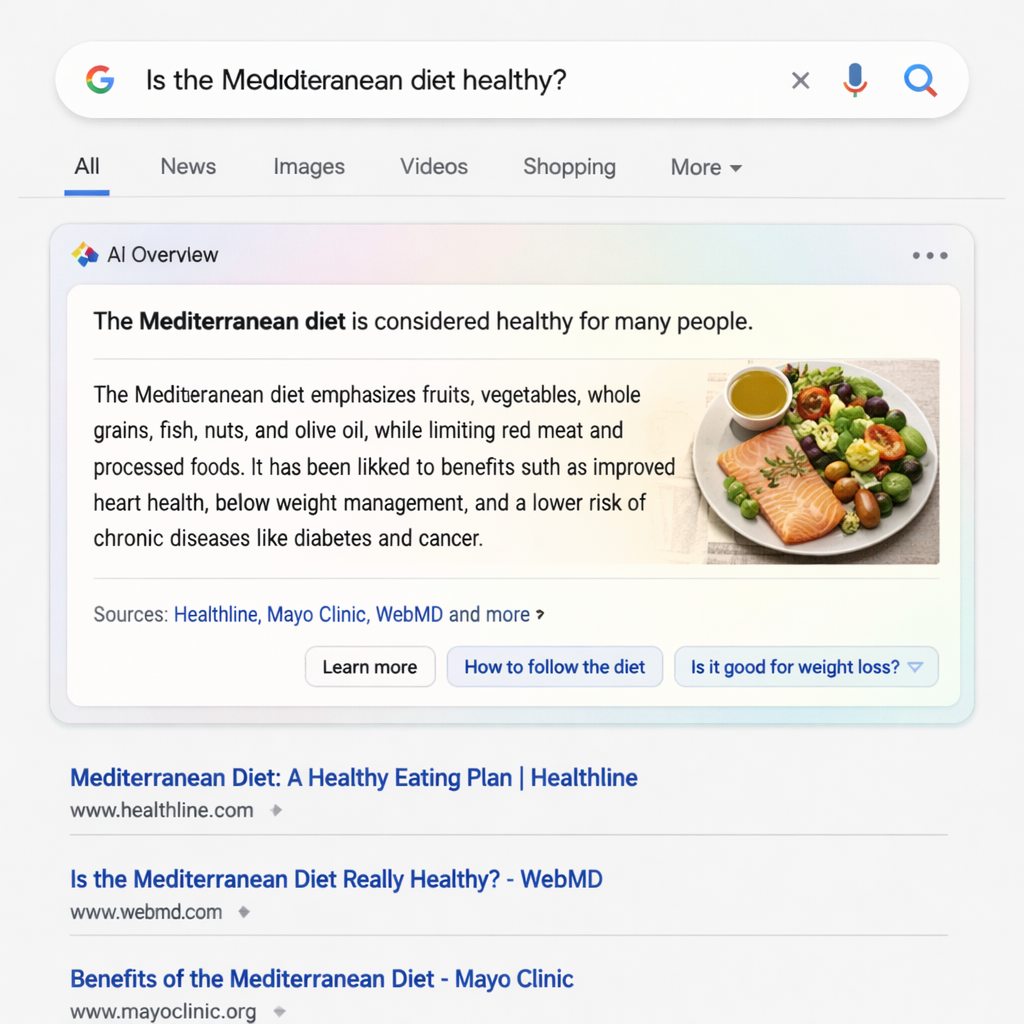
When people search for information on Google today, they no longer begin with a list of links. Instead, they are presented automatically with an AI-generated answer at the top of the page.
This answer is built by machine learning that reads thousands of articles, sources, websites, and papers, and condenses them into a short answer. For many years, journalism’s digital revenue came from clicks on the website, but now, with AI-generated answers, users get their answers, read, and leave. This results in no website clicks or visits that generate revenue.
According to Digiday, since Google introduced AI overviews, more people have stopped clicking on articles, and the share has risen from 56% to 70%. So 70% of these news searches lead to people not even touching an article.
Although these AI answers might be efficient, they are not optimized for understanding. They create a false impression, leading people to believe they are fully informed without knowing the sources or methodology. This is what media scholars call surface-level literacy: being aware that something is happening without knowing why it matters or if it is true.
People used to access news by clicking and reading. They typed the question, search results showed up in blue-highlighted links, and you clicked through to the website/article that included a full article for that one question. These publishers generated ad revenue and page visits, and sometimes subscriptions, while users got context and details.
Art Direction by Eden Joseph | Art by ChatGPT
With this shift to AI summaries, search pages now show an AI-generated answer right at the top before any of the links are shown. These summaries answer the main question, so people do not really click through any links because they believe they have their answer. This leads to fewer visits to websites, which worries publishers since they lose ad traffic and revenue.
This is not the only problem. People are increasingly relying on AI chatbots for answers instead of going to a news outlet. A 2025 Pew Research survey found that 34% of adults have used ChatGPT. Chatbots can give biased answers, and it could be controversial.
Jonathan Rice, an AI Ethics Trainer at Handshake, said that while this may not be an issue yet, it is a growing concern because many people are accustomed to accepting AI-generated responses without additional research. This change might lead people to rely more on shortened responses than on in-depth reporting from original news sources.
ChatGPT, Claude, Gemini, and Perplexity are among many AI chatbots that did not produce knowledge on their own but instead gained knowledge by reading vast amounts of human-written material, including decades of reports, articles, and investigative journalism.
Now, these chatbots and AI overviews give us a complete, on-the-spot answer without having to click on an article. According to a 2025 Zyppy article, these answers sometimes include a few links or citations, but users often feel they have the answer they need and do not visit the original news site. This sends less traffic to individual stories.
Press enter or click to view image in full size

AI is using journalism, but journalists and news organizations often don’t get paid for it. AI increased consumption, but compensation went to zero. When people stop reading news websites, they are losing more than just convenience. Byline, sources, methodology, and journalistic accountability are all lost to them. They are no longer able to judge the quality and source of information. However, AI summaries are optimized for efficiency. They provide what they want based on “what” but never really who, why, and how, the components that turn unfiltered information into news.
Rice said as more people use AI tools to get news, the risk is that information may be “wrong” or even “hallucinated,” which matters in journalism because accuracy needs to be as accurate as possible. When AI chatbots generate information that seems believable but is completely fabricated or factually incorrect, this is referred to as AI hallucination.
AI is unaware that it is erroneous. It communicates the misleading information with the same confidence as factual information. For this very reason, journalism has norms that AI does not. Before publishing, reporters ensure the facts are accurate, claims are reviewed by editors, and sources are identified as being accountable. When mistakes are made, corrections are made public. None of these methods is presented in AI.
AI will never replace journalism, especially if it lacks the safeguards that newsrooms are required to follow. According to an NPR article, AI chatbots should be viewed as additions to journalism rather than substitutes, as they are not sufficiently safeguarded through fact-checking, corrections, and accountability.
Although they can help summarize or explain stories, news organizations are still required to perform essential tasks such as obtaining information, challenging authority, and protecting published content.
There are uses for AI within journalism. For example, the Associated Press uses automation for earnings reports and sports roundups, making this public information. Smaller newsrooms are also using AI for large-scale public record database recording, document analysis, editing, headline-writing and interview transcripts.
AI is not entirely harmful to news, as it brings in benefits but also raises long-term questions about sustainability. Journalists can operate more efficiently and smartly, thanks to AI. According to Chartbeat, since January 2023, Google Discover, an AI-powered, customized content channel, has increased by 13% among Chartbeat clients, making it a top source for news websites. So, rather than just replacing journalism, AI could potentially help broaden its reach.
According to INMA, “early evidence” suggests that other factors, such as weaker news cycles and algorithm tweaks, are also crucial, and AI search overviews have not yet eliminated search traffic on their own. This implies that, rather than being entirely disastrous, the short-term effects are mixed, including some loss, some stability, and even opportunities to engage with various audiences.
The long-term worry, though, is that AI solutions become more advanced and widespread as more users may choose to remain on platforms, thereby reducing the traffic and income that support original reporting.
All of this raises the larger question: how can journalism be preserved if AI continues to use it? Even while people now receive their initial response from an AI box rather than a webpage, newsrooms still require funding to hire editors, reporters, and photographers. This implies that AI organizations have a responsibility to maintain the environment on which they depend, in addition to consuming information from news sources.
AI response should, at the very least, provide a clear link to the original articles so readers can see the entire story and assess the source’s reliability. Strong credit is also essential, since it reminds viewers that actual people, not a machine, did the job. This includes naming the publication and sometimes even the reporters.
However, Ocean Media argues that if the majority of visitors continue to never click through, links and credit alone may be sufficient. Because of this, many publishers and researchers are increasingly demanding payment or licensing when AI systems extensively exploit their work. According to Cloudflare’s investigation, OpenAI’s crawl-to-referral ratio was found to be between 1,200:1 and 1,700:1. In contrast, Google search maintained a ratio of about 10:1. This indicates that OpenAI has already collected the publisher’s content more than 1,000 times for each visitor it sends to that publisher.
News outlets lose power if they can no longer monetize their content. This is a reality of the structure; reporters cannot be paid in a newsroom that is making no money. Journalism that AI relies on to remain consistent and accurate cannot be produced in a newsroom without reporters. Therefore, the free rider problem in journalism works against AI. The quality of its responses will also collapse if the system on which it depends fails.
In April 2024, eight newspapers owned by Alden Global Capital filed a lawsuit against OpenAI and Microsoft, claiming that AI models use publishers’ content without payment, rob publishers of site traffic, reduce ad and subscription revenue, and threaten the overall value of their businesses.
In December 2025, The New York Times filed a lawsuit against Perplexity after 18 months of unsuccessful licensing discussions. The main defense offered by AI organizations is fair use, a legal theory that allows limited use of copyrighted content for creative purposes. The question of whether it is fair use to train huge language models on unlicensed copyrighted content will probably become the focus of expensive, drawn-out legal disputes that eventually make their way to appeal to courts.
Aside from the case against Perplexity, The New York Times also filed a case against OpenAI and Microsoft for allegedly using millions of newspaper articles to train their AI chatbots without permission or compensation. The two companies have defended themselves by citing the doctrine of “fair use,” which is a legal concept that allows the limited use of copyrighted content for different purposes. However, it is still unclear if fair use of copyrighted content for AI system training is allowed.
But some places can’t afford legal help: an independent publication that represents underserved communities, a student-led news club at a public university, or a community newspaper that covers local news. A licensing agreement will not be accessible to any of them. To survive, none of them can lose 38% of their search traffic.
In any case, they create journalism, and nevertheless, it is consumed by AI. Furthermore, the communities they serve lose the only organization that holds local authorities responsible when newsrooms close. With well-funded foreign publishers gaining an advantage and local news organizations sometimes being overlooked in discussions about AI news, the growing usage of AI is expected to worsen already existing disparities across news organizations.
There are three ways to address the free-rider problem: litigation, legislation, or licensing. At the moment, all three are being followed out at the same time, and none of them is advancing quickly enough to cause newsrooms to vanish. We will have fewer sources, poorer journalism, and a less informed public if we let the search monopoly restrict internet access through summaries generated by artificial intelligence. But it becomes more likely every day that AI companies are allowed to build billion-dollar products on journalism’s foundation without being required to sustain it.
AI answers seem natural. People ask a question, and within seconds, you receive a clear, self-assured narrative that explains what happened. AI answers seem natural. No paywalls, pop-ups, or reading through lengthy articles. Less time, fewer issues, and greater efficiency make it feel like an upgrade. However, everything that makes journalism, journalism, is lost in the process, the headline. The process. The proof. The editorial choice. All of that is compressed into a paragraph that seems to have appeared out of nowhere.
Real journalism is expensive, time-consuming, and even uncomfortable. Reporters sit through lengthy meetings, file records requests, phone people who do not want to talk, and ask questions that those in positions of control would prefer to avoid. Editors correct information, push back, and at times filter out stories that don’t stand up. When the truth is risky, lawyers interfere. The purpose of the entire system is to provide readers with more than just information. When you read a story, it has been verified, discussed, and owned by the person whose name is on the line.
AI, on the other hand, has none of those responsibilities. The courthouse is not visited. It doesn’t knock on doors. It transforms existing text patterns and displays them in an accessible way. AI can be useful, particularly for background, explanation, and translation; therefore, that doesn’t mean it’s worthless. However, if we begin to view AI-generated answers as a complete replacement for reporting, we tacitly support information that lacks a clear source, accountability, or proof that anyone has put in the necessary effort. Because AI currently exists and can be a helpful tool, the question is not whether it should be used in the news.
What we’re willing to give up for convenience is the true question. We risk creating an information system that feels effortless but is built on declining, inadequately funded journalism if we allow AI responses to stand in the way of original reporting and stop promoting the sources below.
As news traffic declines, journalism as a whole will also suffer. If an apparently effortless information system depends on underpaid newsrooms to generate the facts it summarizes, it cannot be sustained. AI won’t replace journalism if it doesn’t provide real visibility, credit, and funding for original reporting; instead, it will subtly weaken the conditions that allow it.
FAQ
Q: How is AI changing the way people find news on search engines? A: Instead of starting with a list of blue-highlighted links, people using Google are now automatically presented with an AI-generated answer at the top of the search page. These summaries are built by machine learning models that read and condense thousands of articles into a single short answer. As a result, users often read the summary and leave, with 70% of news searches now leading to people not even opening an article.
Q: Why is this drop in traffic a major problem for news publishers? A: For years, journalism’s digital revenue has relied on website clicks to generate ad revenue and subscriptions. When users get their answers instantly from AI and don’t click through to the website, publishers lose their ad traffic and income. This creates a “free-rider” problem: AI uses human-written journalism to generate answers, while the original creators receive zero compensation.
Q: Does using AI for news affect the public’s understanding of current events? A: Yes, media scholars warn that AI summaries can lead to “surface-level literacy,” which means people are aware that something is happening but do not know why it matters or if it is actually true. AI answers are optimized for efficiency rather than deep understanding; they provide the “what,” but often leave out the “who, why, and how” that turn basic information into true journalism.
Q: What is an “AI hallucination” and why is it dangerous for news? A: An AI hallucination happens when chatbots generate information that seems believable but is factually incorrect or completely fabricated. The danger lies in the fact that AI is unaware that it is wrong and communicates misleading information with the same confidence as factual truth.