


By Emilia Wawryniuk and Olivia Kasza
@redlineproject
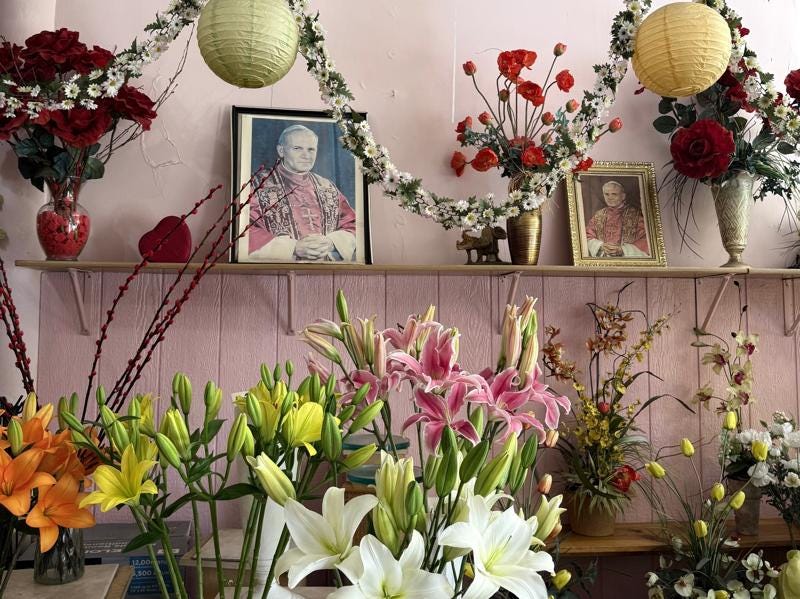
Portraits of Pope John Paul II decorate the walls of Szarotka Flowers, a reminder of the cultural and religious roots that once defined the neighborhood. (Photo/Emilia Wawryniuk)
For decades, Polish immigrants shaped the neighborhood through local stores, churches, restaurants and cultural traditions. However, now current residents are witnessing a change, especially in a business sector that is no longer reflecting Polish culture.
Historian Dominic Pacyga, an emeritus professor at Columbia College Chicago and an affiliated faculty member at the University of Illinois Chicago in the History Department, offered context into how Polish culture became so popular near the Jackowo area.
The Jackowo area refers to a historic Polish neighborhood centered around St. Hyacinth Basilica on the Northwest Side of Chicago, particularly near the intersection of Milwaukee, Lawrence and Central Avenues. Often called “Polish Downtown”, Jackowo became a cultural and social hub for Polish immigrants in the late 19th and early 20th centuries.
Dr. Dominic Pacyga, historian and expert on Polish Chicago, discusses
the history and transformation of Jackowo in a Zoom interview.
Polish neighborhoods began to develop as Poles decided to move near Ashland, Division and Milwaukee avenues, which bordered churches like St. Hyacinth, as well as Chicago’s first Polish parish, St. Stanisław Kostka, founded in 1867.
However, the cause of the current lack of Polish presence happened in the early 2000s as families started leaving Jackowo and the surrounding areas into suburban neighborhoods.
“Today, most Polish Americans live in the suburbs,” Pacyga said. “At one point, there were almost 400,000 Poles in Chicago. Today, there are about maybe 140,000, 135,000 (Poles) spread throughout the city.”
However, as residents decided to slowly move out, Polish businesses began to disappear as well, resulting in the lack of Polish culture in the once heavily Polish populated neighborhoods. According to U.S. Census data, Polish populations in key Northwest Side neighborhoods declined sharply, including a 41% drop in Portage Park and a 55% drop in Belmont Cragin since 2000, with similar declines across nearby areas.
Pacyga said, “There are only a few Polish stores left on Milwaukee Avenue in that area. One restaurant, Staropolska, which is a favorite place of mine.”
He mentioned that these are patterns in Chicago neighborhoods, where immigrant communities establish a strong sense of culture, and end up eventually moving out due to economic conditions and personal interests.
“I don’t think it’s actually disappearing. I think it’s changing,” he said, as he talked about Polish culture regardless of geography.
While few Polish residents remain in Logan Square, many Polish customs and traditions are still seen in Chicago, such as the big Trzeciego Maja (May 3, Polish Independence Day) parades and many other churches that hold Polish masses. However, this cultural presence exists alongside major population loss: the city’s population has declined for nine consecutive years, losing over 128,000 residents since 2014, including more than 8,000 people in just one recent year.
For some business owners, these traditions are essential for survival.
“Thank God for the St. Hyacinth Basilica,” said Stanisława Jóźwiak, owner of Szarotka Flowers in Logan Square. She said that the church continues to bring customers to her shop around important Polish holidays.
Jóźwiak, who has owned Szarotka Flowers since 1996, has witnessed the neighborhood’s transformation firsthand. While the church still brings moments of business, daily reality has become increasingly difficult.

Inside of Szarotka Flowers, one of the few remaining Polish-owned businesses in Logan Square.
(Photo/Emilia Wawryniuk)
“Rent and utilities are getting more and more expensive,” she said. “I don’t know how much longer I can stay in business.”
She remembers a time when Polish culture dominated the area, especially along Milwaukee Avenue.
“Every second store used to be Polish”, she said. “Now there are four Polish business owners left on the Milwaukee strip.”
For Jóźwiak, the changes are deeply personal. What was once a lively, culturally rich environment has faded.
“There are no more of us,” she emphasised. “It’s hard … it used to feel like Warsaw. The streets were full of life.”
Her experience reflects a broader shift in the former “Jackowo”, where rising costs and demographic changes are not only reshaping the neighborhood, but also changing the sense of community that once defined it.
Logan Square resident Danuta Jagniankowski has lived in the neighborhood for eight years after immigrating from Poland to live in Chicago with her parents in 1987.
“Everyone spoke Polish,” Jagniankowski said. “Everyone went to work. I worked at a delicatessen called Bacik.”
She said working in the Polish deli made the neighborhood feel like home.
She would also visit restaurants and bakeries such as Andy’s Deli and Polonez, both of which have since closed, as well as Jabłuszko, one of the few remaining Polish establishments in the area today.
Community services were primarily used by Polish residents since it was similar to a postal office that could allow them to send money and other packages back to Poland.
Nonetheless, she began noticing changes as Polish residents started to move out and the neighborhood began to feel less comfortable.
She later moved and settled west to an area near Belmont, Harlem and Cumberland avenues after buying a home with her husband.
“I was happy because I had my own home and husband,” she said. “There was still sentiment [to Logan Square], it was like a second Poland.”
Asked if Logan Square was losing its Polish identity, she responded, “No, there’ll still be Polish (culture) present because there will still be Polish churches there and restaurants.”
She also emphasizes the importance of Polish churches in the area, explaining that they remain as a cultural significance to the Polish community.
Nonetheless, she’s gone back to Jackowo and noted that much of the Polish presence that was previously present in Logan Square has gradually shifted to West suburbs.
At the same time, she’s observed that Logan Square itself has become more diverse, with lots of young residents moving into the neighborhood as well.
Lastly, she mentions that there was always a sense of mutual support among each other — “Jackowo was a place filled with many Polish people who grew up there, started businesses, and made connections with other Polish people.”
Your Thoughts
As Logan Square continues to change, many are faced with difficult choices. Would you stay in the neighborhood that no longer feels the same, or move on with your community? Share your thoughts on Bluesky at the #uicdigital hashtag.